
AI Labor Tracker
61% of Workers Say They Now Do More Than One Role
ServiceNow says AI let each HR staffer serve more than twice as many employees, with no layoffs. Elsewhere, 61% of workers say they now do more than one role.
61%
Share of more than 16,000 professionals in 11 markets who say they now perform the responsibilities of more than one role (Korn Ferry Workforce 2026, Sep 8, 2026)
Jacqui Canney runs both people and AI at ServiceNow, the enterprise software company. In April, she went on an MIT Sloan Management Review podcast and described what happened when her own HR team started using the company’s AI tools.
“We were able to come to double the productivity of what my team could do,” she told host Sam Ransbotham.
In her telling, each person on the team went from serving about 400 employees to about 900.
Then she added the sentence that makes this story unusual. “Now, I didn’t want people to be displaced because of that.”
Most questions employees send to the company’s AI assistant, over 90% by her count, now get answered by the tech. Her team got better at writing prompts and training the AI. HR also added jobs it never had before, including product engineers and product designers.
Ransbotham said what most listeners were probably thinking. With numbers like that, he said, your first reaction would be “OK, yeah, that’s going to lead to reduction.”
Where does the time go?
Here’s the question I want to answer. When AI makes a team twice as productive and nobody gets laid off, where does the freed-up capacity go?
Ransbotham asked Canney a version of it. Is AI creating more work than it removes, or less?
“A crystal ball would be really good on that one right now,” she said. Her advice to other leaders was to plan for it on purpose: “If you don’t design it, you’ll lose the capacity.”
At ServiceNow, the answer was growth. The company got bigger, and the HR team’s extra capacity went into serving the new people.
At most companies, the data points somewhere else. The work grows, and the same people do it.
ServiceNow’s numbers, and why they don’t match
The published accounts of ServiceNow’s HR ratio disagree a little, so here’s the range.
Canney’s own words, on the podcast, were 400 employees per person before and 900 after. That’s the primary source, and it’s the one I use in this piece.
The two accounts describe slightly different jobs. Read together, they put each HR staffer at somewhere between 900 and about 1,000 employees today.
ServiceNow says AI let each HR staffer serve more than twice as many employees
Employees served per HR staff member
2.25×
Employees per HR staffer: 400 before ServiceNow's AI rollout, 900 after.
Bar chart. Use the up and down arrow keys to move through 2 categories. A data table follows.
Canney, MIT SMR podcast (HR team): Before 400, After 900
Figure 1. Employees served per HR staff member before and after ServiceNow's internal AI rollout. Canney's figures describe her HR team; CX Today's, HR business partners.
Sources: MIT Sloan Management Review podcast (Apr 7, 2026); CX Today (May 25, 2026). Chart: Post Labor Economics Download CSV Methodology
Data table
| account | Before | After |
|---|---|---|
| Canney, MIT SMR podcast (HR team) | 400 | 900 |
| CX Today (HR business partners) | 400 | 1,000 |
Methodology
A May article in CX Today described HR business partners going from roughly 400 employees each to 1,000. It added that this happened “without additional hires and, crucially, without layoffs.”
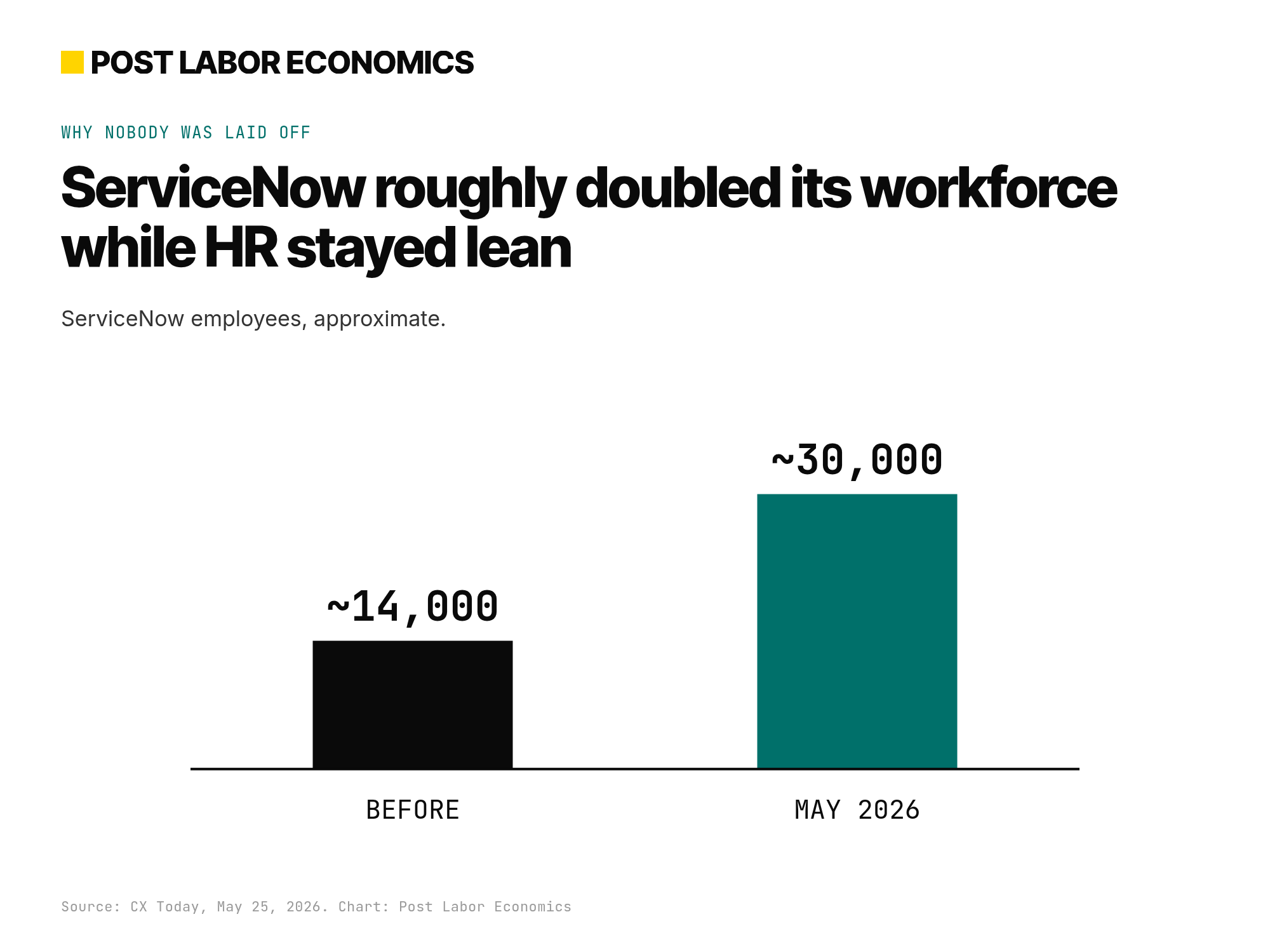
The reason nobody lost a job is that ServiceNow was hiring fast. It grew from about 14,000 employees to nearly 30,000 “without a proportional increase in operational headcount,” CX Today reported.
“What we did was reallocate capacity,” Canney said, as CX Today quoted her. “It did more than double the output of what our people could do in people operations to serve the company as we were growing.”
The IT help desk went the same way. About 90% of tickets now get resolved without a person stepping in, according to CX Today.
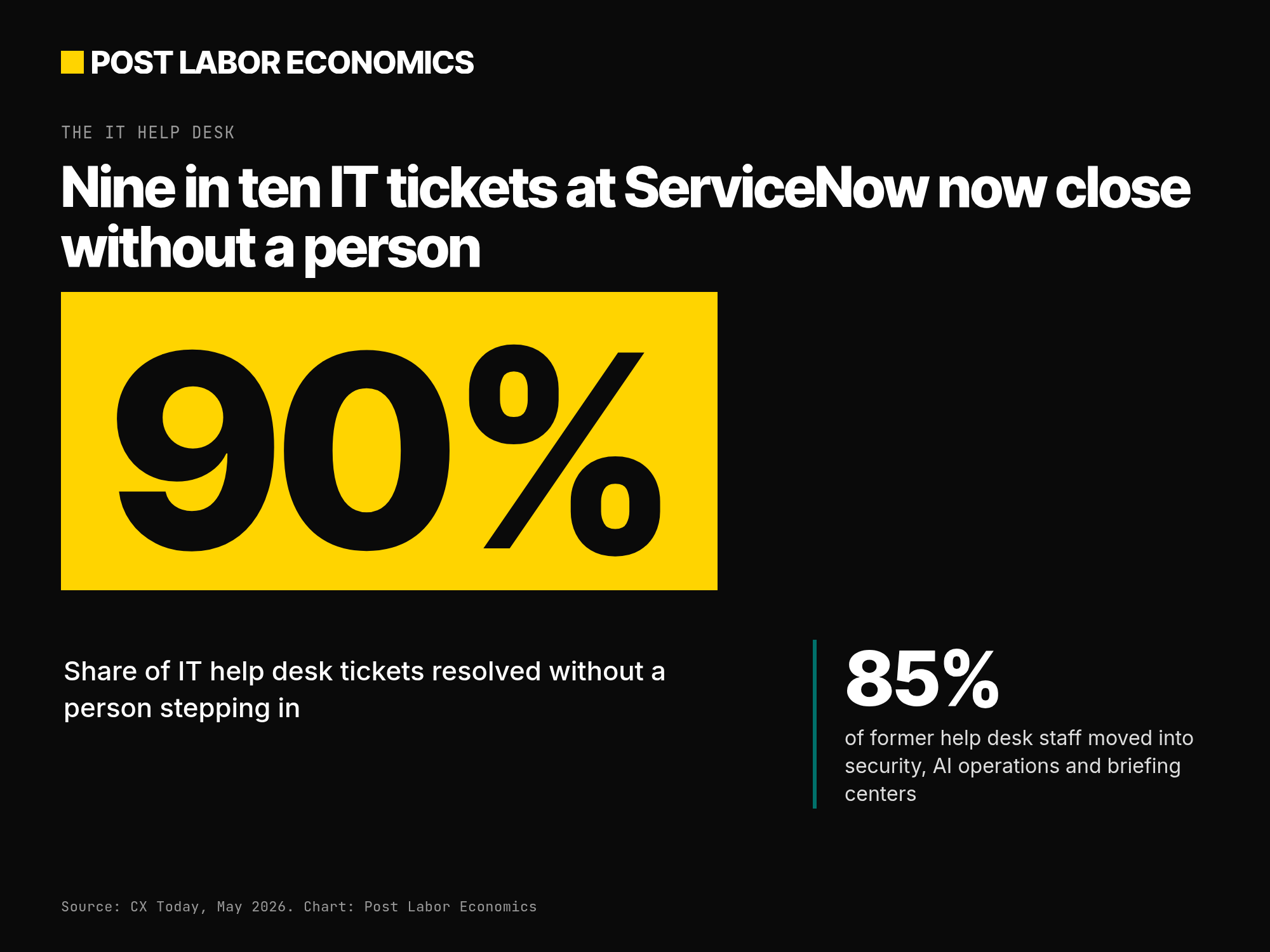
Of the people who used to do that work, 85% moved into security, AI operations and executive briefing centers. The rest now manage the AI agents.
Sales staff got time back as well. Finding out what a commission would be used to take four or five days, Canney said on the podcast. Now it takes eight seconds.
Here’s the limit on all of it. Every number in this section comes from ServiceNow executives, talking about a company that sells this software. Nobody outside the company has audited them.
How typical is the two-job job?
Korn Ferry, the consulting firm, surveyed more than 16,000 professionals across 11 markets for its Workforce 2026 report, released in September.
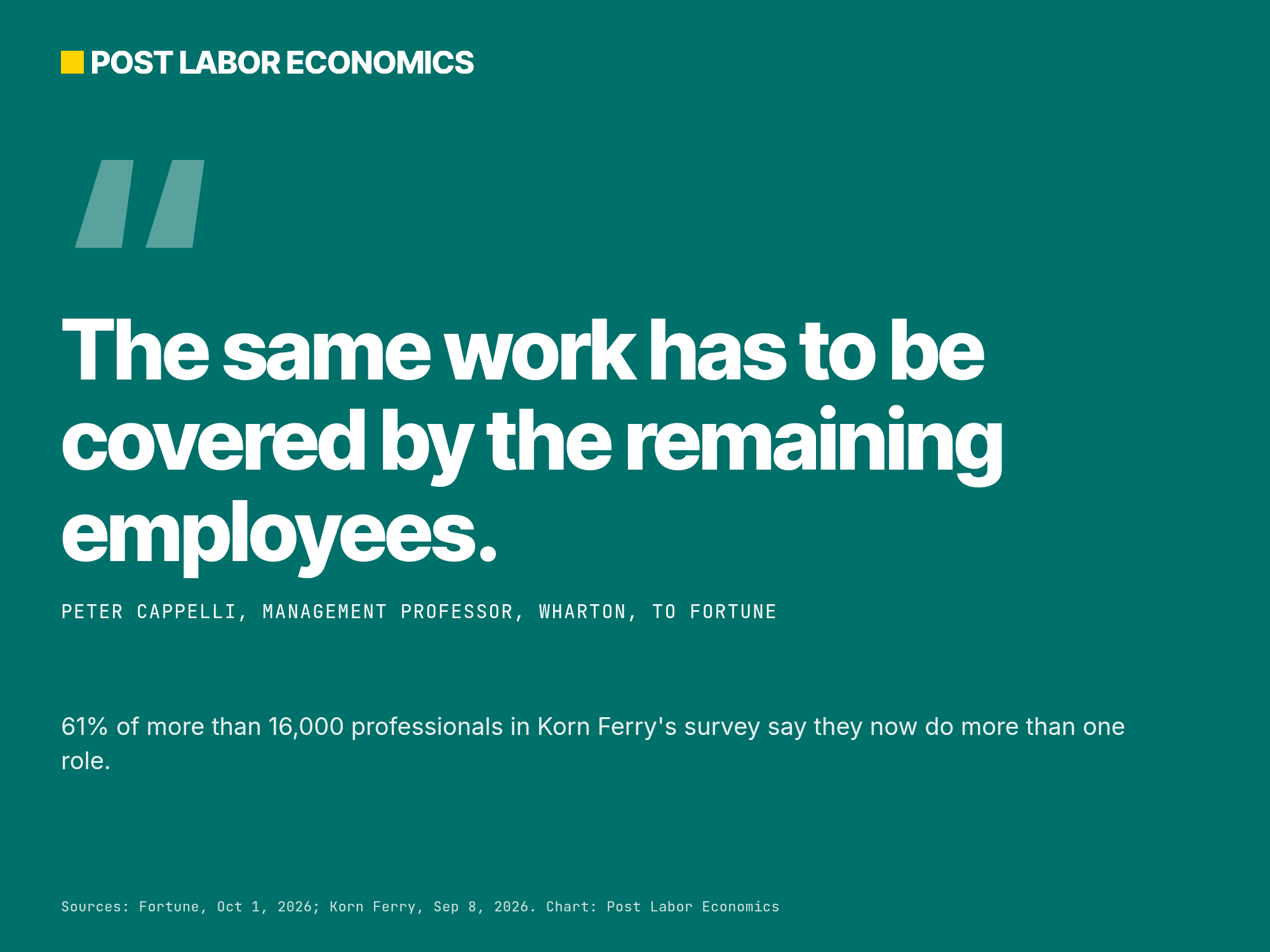
About 62% said their workloads had gotten significantly heavier over the past two years. And 61% said they now handle the responsibilities of more than one role.
Korn Ferry has a name for it, the “two-job job.” When people also have to manage AI on top of their regular tasks, the firm wrote, “it can feel like doing two jobs instead of one.”
The view depends on where you sit. About 79% of CEOs said AI had made their organizations more efficient. Among individual contributors, it was 51%.
Then there are the workers Korn Ferry calls “AI-weary.” Among them, 52% said using the technology had increased their workloads.
Managers are disappearing at the same time. About 42% of organizations cut management roles over the past year, Korn Ferry found.
Of the managers who remain, 55% say they’re exhausted.
Motivation is harder to read. This year 61% of employees across the 11 markets said they’re motivated. Korn Ferry’s 2024 wave, a smaller survey of six markets, put it at 71%, so the two waves aren’t a strict like-for-like comparison.
61% of workers say they now do more than one role
61%
Share of 16,000+ professionals in 11 markets doing more than one role, 2026.
62% say their workload got significantly heavier in the past two years.
Figure 2. Korn Ferry Workforce 2026 survey of 16,000+ professionals in 11 markets. Both figures are shares of all respondents.
Source: Korn Ferry, Workforce 2026 report, Sep 8, 2026. Chart: Post Labor Economics Download CSV Methodology
Data table
| indicator | Share |
|---|---|
| Workload significantly heavier over past two years | 62% |
| Performing responsibilities of more than one role | 61% |
I wanted to compare countries here, and I can’t. Korn Ferry’s release gives pooled figures for all 11 markets and no country breakdown, so I don’t know whether this is worse in the U.S., Britain or Asia.
Peter Cappelli, a management professor at Wharton, put the core problem plainly to Fortune. “The same work has to be covered by the remaining employees,” he said.
“It is in fact a misnomer to say that jobs are cut,” he added. “It is employees that are cut.”
Korn Ferry’s own consultants say much the same. Roger Philby, who leads the firm’s people strategy work, said in the release that “adding more technology without expanding workforce capacity clearly is not the answer.”
What it looks like at the desk
The best close-up look I found comes from UC Berkeley’s Haas School of Business. Doctoral student Xingqi Maggie Ye spent eight months observing a U.S. tech company of about 200 people, with more than 40 interviews, alongside associate professor Aruna Ranganathan.
AI didn’t free up anyone’s time. “Employees worked at a faster pace, took on a broader scope of tasks, and extended work into more hours of the day, often without being asked to do so,” they wrote, as Haas News reported in February.
Ye saw it happen in three ways. People took on work that used to belong to someone else, and they sent prompts during lunch, before meetings and in the evening.
They also kept several threads going at once.
“They would run AI processes in the background while reviewing code, drafting documents, or attending meetings,” Ye said. “Some even ran multiple AI agents simultaneously.”
She described the trap like this. “Increased capability leads to increased output, which leads to higher expectations, which then pressures further expansion.” Over time, she said, “what was once extra effort becomes standard performance.”
It’s one company, and the research is still in progress. But it lines up with what Korn Ferry found across 16,000 people.
Some of the extra work is checking the machine’s output. Mary, a former content writer in the Philippines whose name the BBC changed, said her employer pushed AI as a productivity tool.
“We had to edit more, fact-check more because the data AI produced was inaccurate,” she told the BBC. “Technically it was more work for us.”
She was later made redundant.
Building the AI tools is work too. A two-year field study of a law firm and an academic medical center, by researchers at Stanford, MIT Sloan and NYU, found that most of that effort sat on top of people’s regular jobs, Fortune reported.
At the law firm, more than 80% of the experts eventually dropped out of the AI projects. The medical center, which wrote the AI work into job duties, reviews and promotions, ended up with 141 tools in use, against the law firm’s three.
“Leaders often assume AI experimentation is a stretch assignment that motivated employees will absorb on top of their regular responsibilities,” said Kate Kellogg of MIT Sloan, one of the authors, as Fortune quoted a university release. “Without meaningful support, recognition, and resources, people eventually disengage.”
Who gains, and who pays
I’ve felt the benefit myself. In a 2024 podcast conversation with Kevin Dean of ManoByte, I said, “Already I do things like have … ChatGPT review any non-disclosure agreement, … any MSA I’m signing, anything like that. And it’s amazing at how fast it can do it, how accurately it does it.”
But I own my company. When AI saves me an hour, I decide what happens to that hour. Most people don’t get to decide.
At ServiceNow, the gain went into growth. The company roughly doubled its workforce without hiring HR staff at the old ratio, and the HR staff it already had moved into newer, more technical work.
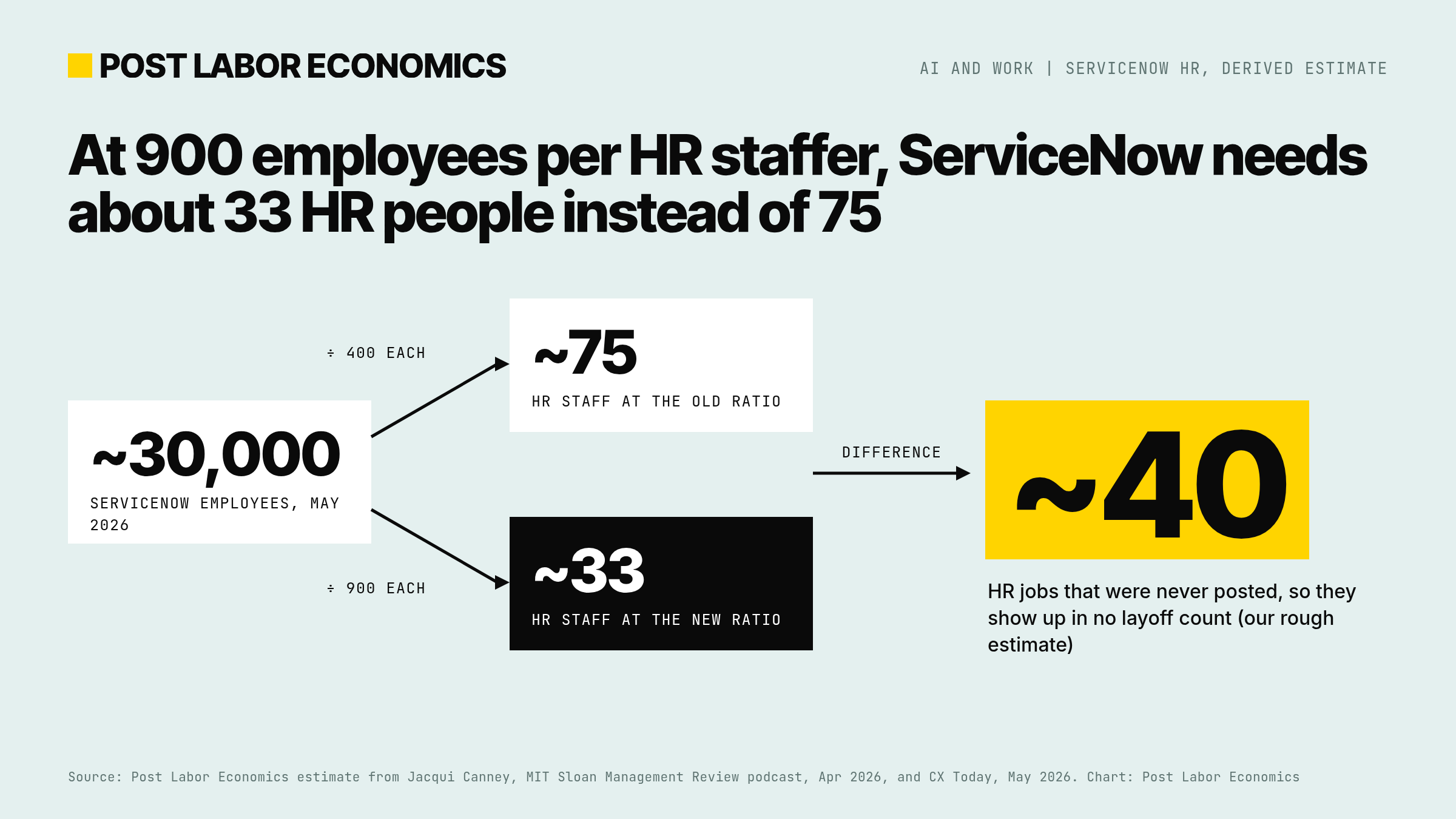
Here’s one rough number, and it’s my own derived estimate. At ServiceNow’s current size, 400 employees per HR staffer would mean roughly 75 people.
At 900 each, it’s about 33.
That leaves roughly 40 HR jobs that were never posted. Nobody was fired from them, because nobody ever held them, so they show up in no layoff count.
The people who pay are the ones holding two jobs. They pick up the work of colleagues who left, plus the work of managing the AI, and few of them got a raise or a new title for it.
Even the people running these programs feel the pressure. Canney had a blunt warning for her own profession on the podcast: “If you’re a [chief human resources officer] who’s really focused on process and policy and annual cycles, the CIO is going to come for you.”
That’s the same squeeze, one level up. HR is being asked to run the AI, redesign the work and keep the people, all at once, and the leaders who don’t adapt risk having the job absorbed by IT.
Korn Ferry’s own press release ends with the firm’s tagline, “the bold ambition to Be More Than.” For 61% of its respondents, that’s already the job description.
My read: ServiceNow shows that productivity gains don’t have to mean layoffs, but only while the company is growing fast enough to use them. When growth slows, a team tuned to 900 employees per person doesn’t go back to 400. That ratio becomes the benchmark the next team gets measured against.
The limit on my view is that I’m comparing one company’s self-reported numbers with a consultancy’s survey, and neither one tracks pay. If I saw evidence that people doing more than one role are being paid for it, I’d change my mind.
Where ServiceNow stands now
As of CX Today’s May report, ServiceNow had nearly 30,000 employees, and its HR business partners were serving about 1,000 of them each. The company said nobody had been laid off to get there.
Canney’s warning to other companies, as CX Today quoted her, was about holding on to the gain. “You have to track capacity, because otherwise you lose it.”
Employees should track it too. If AI has added a second job to yours, write down every task you’ve picked up in the past two years, and bring that list to your next review with a request to have the extra role named in your title or paid for. That’s my recommendation.