
AI Labor Tracker / Pay and Prices
Household Income Is Up. Paychecks for Full-Time Degree Holders Fell in 2025
Median household income reached a record in 2025, as one All-In host said. But pay for a typical full-time worker with a degree fell after inflation, and new graduates in AI-exposed fields took the hardest hit.
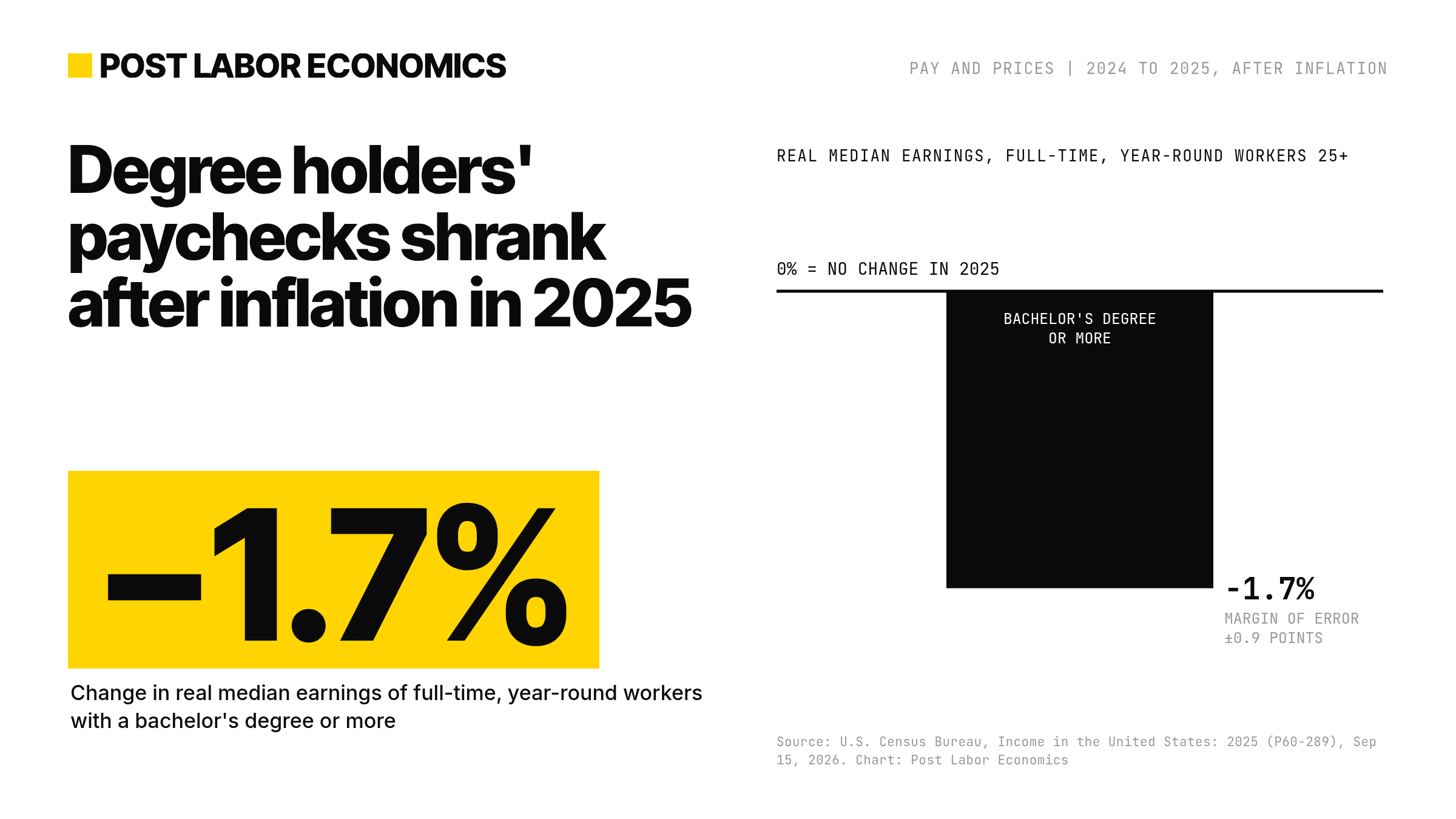
−1.7%
Change in real median earnings of full-time, year-round workers with a bachelor's degree or more, 2024 to 2025 (Census Bureau, Sep 15, 2026)
Jack Zemke sent out hundreds of job applications as a computer science student at Tulane, and most of them vanished without a reply. With graduation days away, he was thinking about moving back in with his parents, the Associated Press reported.
His break came at an engineering conference, where he was showing off a group project built around an AI search tool. A man from a civil engineering firm walked up and said the firm needed “somebody to be essentially an evangelist” for AI.
“I’m your man,” Zemke said.
He spent a year there, then got hired this summer at an AI startup. He’s 23, and he doesn’t describe the market as calm.
“There’s so much churn,” he told the AP. “People are getting laid off. People are leaving. It really feels like a total frenzy right now.”
Zemke landed on his feet. Many people who studied what he studied haven’t. Unemployment for recent computer science and computer engineering graduates is around 7.1%, by the AP’s analysis.
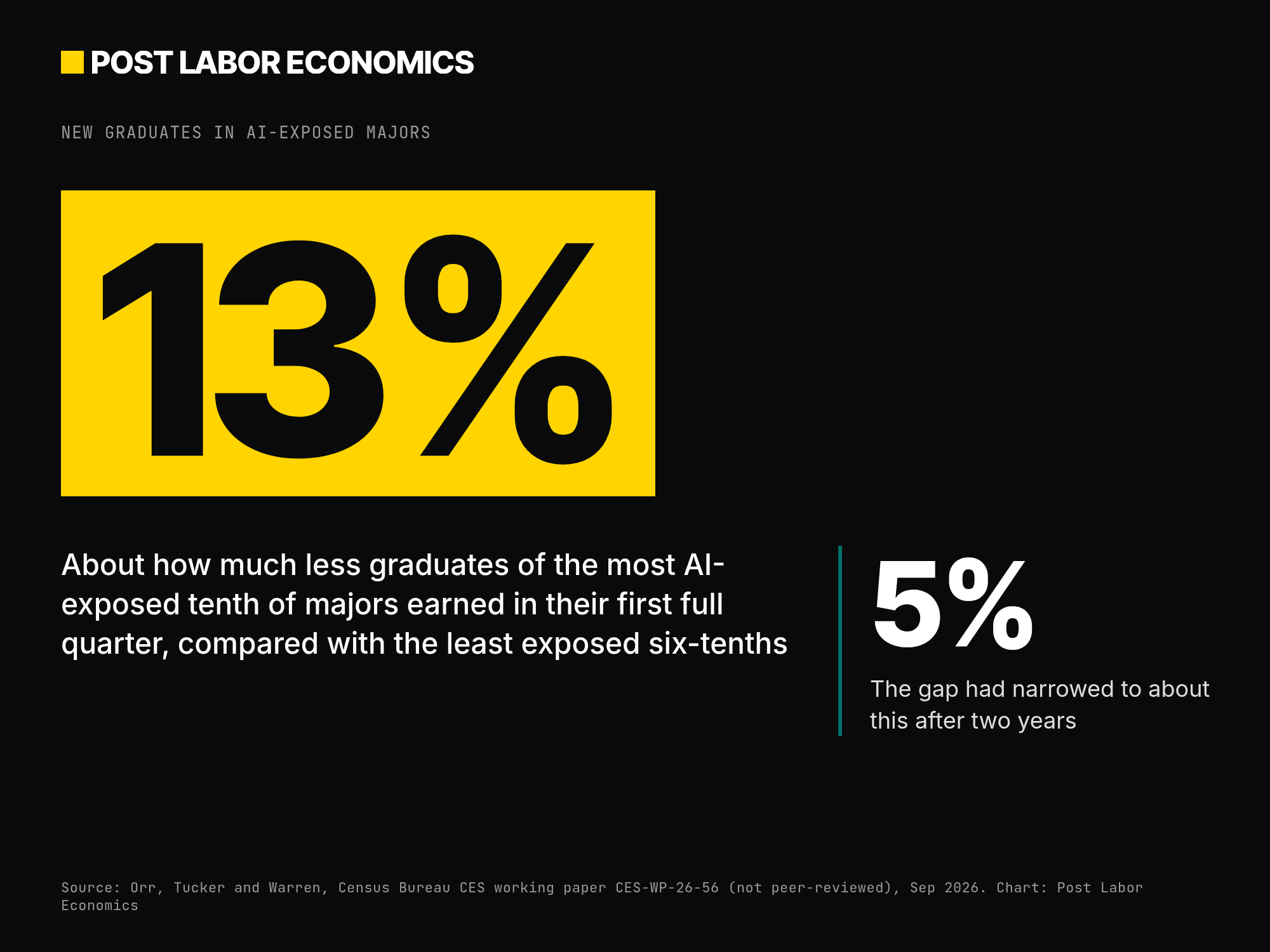
Graduates from the most AI-exposed tenth of college majors saw their pay in their first full quarter after school drop about 13% compared with graduates in the six-tenths of majors least exposed to AI, a Census Bureau working paper found in September. Those majors are mostly computer science, information systems and related fields.
The authors, Cody Orr, Lee Tucker and Lawrence Warren, wrote that the drop “is comparable in magnitude to the earnings losses associated with graduating into a large recession.” The paper hasn’t been peer-reviewed yet.
That’s one side of the paycheck story right now. The other side was a record, announced on September 15, nine days before Zemke’s story ran.
A record that’s real
Median household income reached $87,460 in 2025, the Census Bureau reported on September 15. That’s up 2.6% from 2024 after inflation, and the highest since the series began in 1967.
On the October 30 episode of All-In, one of the hosts asked, “Sacks, has your view changed?” David Sacks started with the polls, then turned to the economy.
“Median household income is almost $90,000. It’s at an all-time high,” Sacks said. “Poverty is at an all-time low.”
He went on: “You’re seeing real wage growth in real terms by the average household, which was not true during the Biden years.”
Median household income hit a record $87,460 in 2025, about 2.5% above 2019
2025 dollars
$87,460
Real median household income, adjusted for inflation to 2025 dollars.
Line chart. Use the left and right arrow keys to move through 7 periods. A data table follows.
2025: Median household income 87,460
Figure 1. US real median household income, 2019 to 2025, in 2025 dollars.
Source: U.S. Census Bureau, Income in the United States: 2025 (P60-289), Table 2, Sep 15, 2026. Chart: Post Labor Economics Download CSV Methodology
Data table
Current Population Survey, Annual Social and Economic Supplement. Adjusted with the chained CPI-U. 2019 to 2025 change is my calculation; margins of error in the CSV.
| year | Median household income |
|---|---|
| 2019 | 85,320 |
| 2020 | 83,590 |
| 2021 | 83,270 |
| 2022 | 81,460 |
| 2023 | 84,730 |
| 2024 | 85,210 |
| 2025 | 87,460 |
The upside is real. Household income in 2025 was the highest Census has recorded, and it finally climbed back past where it stood in 2019.
But it took six years to get about 2.5% past 2019, by my arithmetic from Census’s Table 2.
The six years before the pandemic, 2013 to 2019, brought a gain of about 19%, CBS News calculated.
Checking the claims
Here’s how each of Sacks’s numbers holds up.
Growth “2 and 1/2% in the last quarter”: wrong. The economy grew at a 3.4% annual rate in the third quarter of 2026, the Bureau of Economic Analysis reported on October 29, the day before the show.
The quarter before that came in at 2.2%. Neither matches.
“Tracking at 3.7% right now”: not at the time. The Atlanta Fed’s GDPNow model put fourth-quarter growth at 3.2% on October 29.
It reached that 3.7% on November 2, three days after the episode. Nowcasts move a lot this early in a quarter.
Median household income “almost $90,000,” at a record: mostly right. It was $87,460, and it is a record.
Poverty “at an all-time low,” at “like 12%”: wrong on the number, close on the low. The official poverty rate fell to 10.2% in 2025, which Census called “one of the lowest rates on record.”
Census also says that rate “was not statistically different from the 2019 poverty rate of 10.5 percent.” So it’s tied for the low, and nowhere near 12%.
Census’s broader measure, which counts government benefits and costs like medical bills, was 13.1%. That rate didn’t significantly change from 2024.
Real income gains for households: right for 2025. The household median rose 2.6% after inflation.
“Not true during the Biden years”: partly right. Real median household income fell in 2021 and 2022, then rose in 2023 and 2024, according to Table 2.
These numbers will keep moving. The October jobs report is due November 6, October consumer prices and real earnings follow on November 10, and the second estimate of third-quarter GDP comes November 25.
Where the paycheck didn’t keep up
The household number and the paycheck number aren’t the same thing. A household can earn more because more people in it work, or work full-time all year.
That happened in 2025. The number of full-time, year-round workers rose about 1.7%, to about 124 million, in Census’s earnings table.
What each of those workers earned is a different story. Real median earnings for full-time, year-round workers with a bachelor’s degree or more fell 1.7%.
Workers with only a high school diploma lost 0.7%. Those with some college lost 1.1%.
Younger workers, ages 25 to 34, lost 1.6%. Census flagged all four declines in its report.
After inflation, full-time pay fell in 2025 for degree holders and workers 25 to 34
Percent change in real median earnings, 2024 to 2025
−1.7%
Change in real median earnings for full-time workers with a bachelor's degree or higher.
Bar chart. Use the up and down arrow keys to move through 6 categories. A data table follows.
All full-time, year-round workers: Change 2.1%
Figure 2. Change in real median earnings of full-time, year-round workers, 2024 to 2025, by education and for ages 25 to 34.
Source: U.S. Census Bureau, Income in the United States: 2025 (P60-289), Table 11, Sep 15, 2026. Chart: Post Labor Economics Download CSV Methodology
Data table
Education groups are ages 25 and older. Census reports declines for high school, some college, bachelor's or higher and ages 25 to 34; the overall and no-diploma changes are not significant. Margins of error in the CSV.
| group | Change |
|---|---|
| All full-time, year-round workers | 2.1% |
| No high school diploma | −0.1% |
| High school, no college | −0.7% |
| Some college | −1.1% |
| Bachelor's degree or higher | −1.7% |
| Ages 25 to 34 | −1.6% |
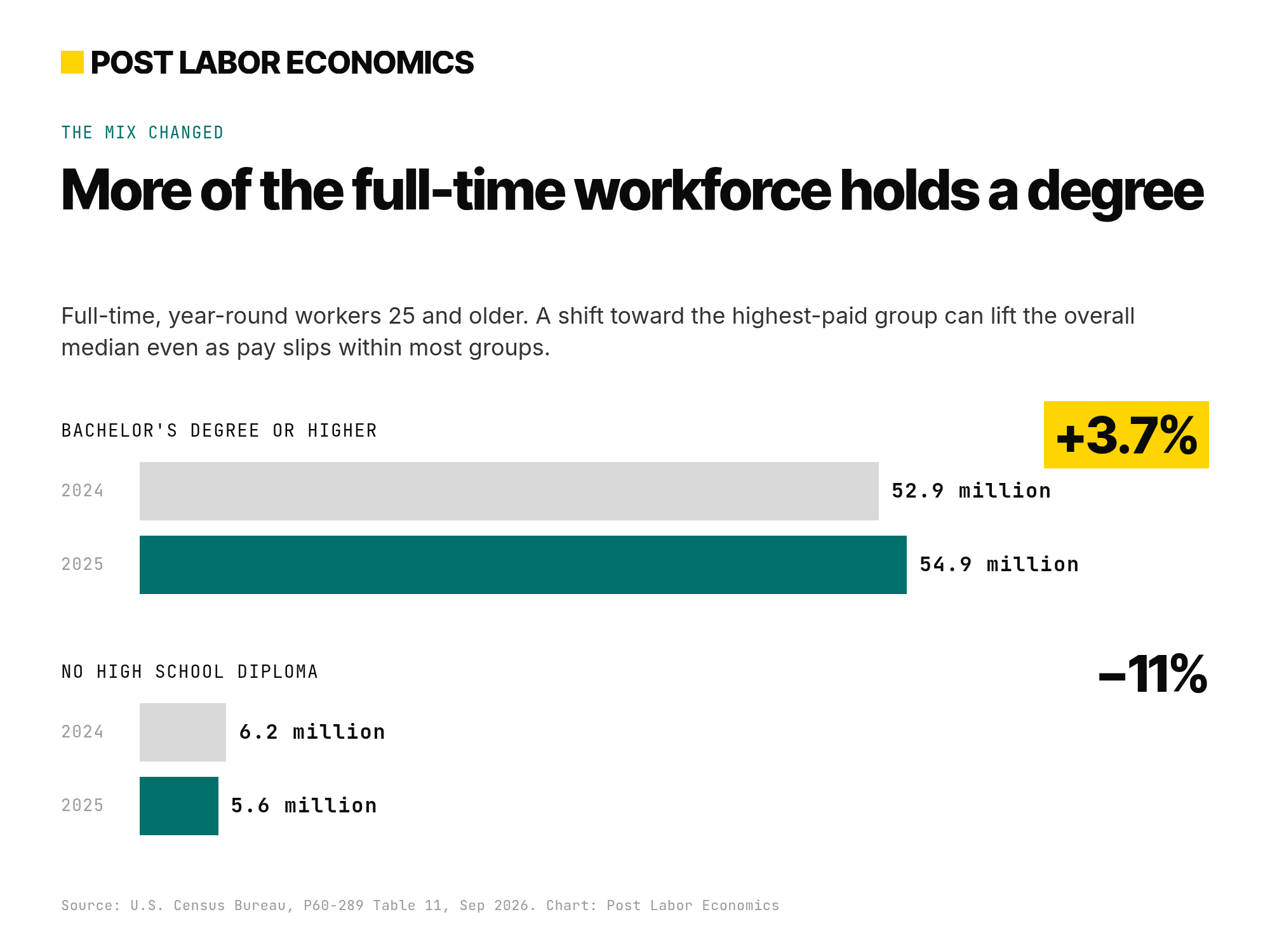
If most education groups lost ground and none gained significantly, how did the overall median stay flat or rise? The mix of workers changed. Among full-time, year-round workers 25 and older, the number with a bachelor’s degree or higher rose 3.7%, from 52.9 million in 2024 to 54.9 million in 2025, while the number without a high school diploma fell 11%, from 6.24 million to 5.56 million, per Census Table 11. A shift toward the highest-paid group can lift the overall median even as pay slips within most groups.
That’s an inference from the table, not something Census says. But it fits the pattern in faster data.
The Bureau of Labor Statistics found real average hourly earnings fell 0.7% in the year to September 2026, in its Real Earnings report. Real weekly earnings slipped 0.1%.
The Employment Cost Index tells the same story. Private-sector wages rose 3.1% in the year to September while consumer prices rose 3.7%, BLS reported on October 30.
Who’s winning and who isn’t
Start with households. The biggest gains went to households headed by people 35 to 44, up 5.1%, in Census’s Table 1.
Households headed by people 55 to 64 did even better, up 5.9%. For households headed by someone under 35, Census couldn’t separate the change from noise.
The top pulled a little further ahead. Household income at the 90th percentile rose 1.7%, while the 10th percentile didn’t change significantly.
Women working full-time all year did better than men. Their median earnings rose 3.2%, while men’s didn’t change significantly, and women now earn 83.9 cents for each dollar men earn.
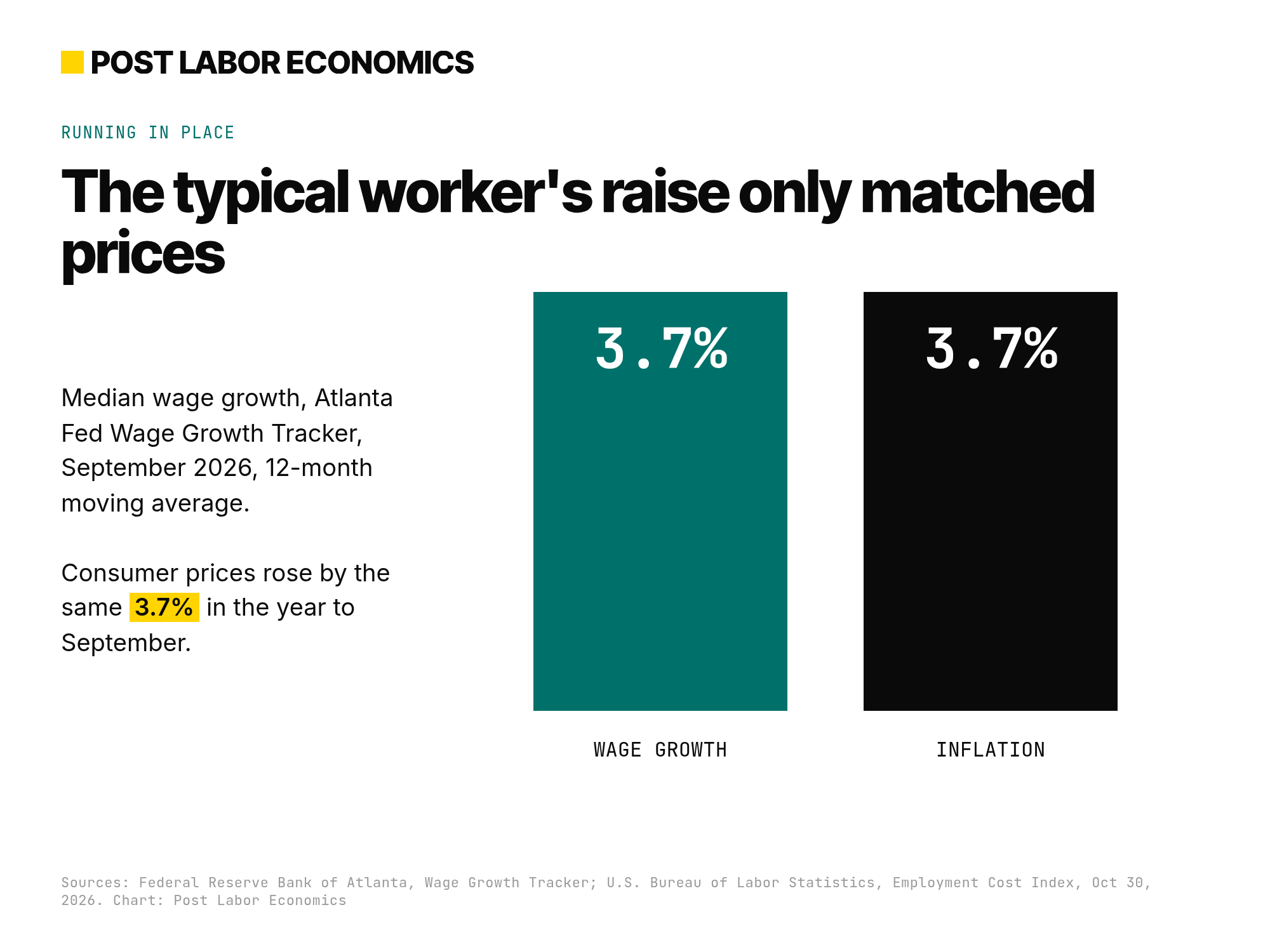
The Atlanta Fed’s Wage Growth Tracker, which follows the same people over a year, put median wage growth at 3.7% in September 2026, on a 12-month moving average. That’s the same as inflation, which leaves the typical worker running in place.
The tracker shows the youngest workers doing best, with pay for people 16 to 24 up 6.5%. Workers 55 and older got 2.9%.
Changing jobs paid more than staying put, 4.4% against 3.5%. That’s the usual pattern, and this year it decides whether you fall behind prices.
The education gap that used to favor degree holders has closed. Workers with a high school diploma or less and those with a bachelor’s degree both saw 3.8% wage growth in September 2026.
Two years earlier, in September 2024, it was 4.7% for the first group and 5.3% for the second. Both have slowed, and degree holders slowed more.
By occupation, the ECI showed sales workers’ wages rose just 1.8% in the year to September, and service workers got 2.8%.
Construction and extraction workers led at 3.8%. They’re one of the few groups that kept pace with prices.
The census graduates paper fits here. About half of the earnings drop for AI-exposed majors came from lower pay inside the industries that hire them, the authors found. The rest came from graduates landing in lower-paying industries such as restaurants and retail.
“Graduating into a recession can have scarring effects on new graduates that last five to 10 years after they graduate,” Warren told The Chronicle of Higher Education. “It’s too early to tell if that’s necessarily the case for graduates who are exposed to AI as they are graduating into the labor market.”
The authors found the gap narrowed to about 5% after two years. That’s better than 13%, but it’s still a hole most people don’t climb out of quickly.
Other researchers see the same thing from a different angle. For workers ages 22 to 25 in highly AI-exposed occupations, employment is about 19% below where it would be if it had kept pace with peers in less-exposed occupations, the Stanford Digital Economy Lab found in its August 2026 update.
Employers keep telling schools what they want. Nicholas Mattei, who teaches computer science at Tulane, told the AP that companies say graduates “need to be able to jump into a middle management role as opposed to an introductory or junior developer role.”
That’s an entry-level posting asking for the experience entry-level jobs used to provide.
Tracy Camp, who runs the Computing Research Association, told the AP that employers now want people who can oversee AI tools rather than accept their output blindly. Her group has urged industry leaders to keep hiring at the entry level.
“If they don’t change how hiring is currently happening, they’re not going to have mid-level career people in a few years,” Camp said.
How the US compares
By international standards, US workers have had a weak run. Real wages grew 0.6% in the year to the first quarter of 2026, the OECD reported in July.
The average across its member countries was 2.2%. Those figures predate this year’s energy price jump, so the gap may look different once later data arrives.
US real wages were still 1.4% below their level in early 2021, by the OECD’s count. UK wages were 3.6% above theirs.
None of this means the record household number is wrong. It means a record for households can sit on top of a bad year for many of the individual workers inside them.
Back to the graduates
Zemke got his job by being the person in the room who knew the new tool. Not everyone gets that conversation at a conference.
Collins Kibet, a computer science graduate from Kenya who studied at Southern New Hampshire University, also sent hundreds of applications, the AP reported. Most of his few interviews were with AI bots, and in the rare ones with a person, the tone changed when employers learned he’d need visa sponsorship.
“Everybody just keeps quiet,” he said. He started his own software company.
Back in 2022, I said on my podcast, talking with John Flanagan, “We work a lot with home service companies, and they are dying for more techs. And that’s one of the best jobs. … There are some really amazing jobs out there.” That was before this wave, and it’s still worth remembering that the narrow path isn’t the only one.
If you’re a recent graduate in an exposed field, do what Zemke did. Widen the search past tech companies to the smaller firms and other industries trying to figure out AI, and lead with what you can build with it.