
AI Labor Tracker
Australia's Central Bank Asked Firms What AI Did to Their Headcount. About Twice as Many Said They Slowed Hiring as Said They Cut Jobs.
The Reserve Bank of Australia's business liaison found three in four firms saying AI hasn't changed their headcount at all. Among the rest, slower hiring outnumbered cuts about two to one, and the bank's own data show the weakness landing on young workers in clerical, coding and call-center jobs. Meanwhile the loudest Australian 'AI layoffs' are tangled up with offshoring.
About 13% vs about 7%
Australian firms saying AI led them to slow hiring vs cut headcount over the past year (RBA liaison, June to October 2026; our reading of Graph 8)
On Monday, Sarah Hunter gave a speech at the UBS Australasia Conference in Sydney. Hunter is the Reserve Bank of Australia’s assistant governor for economics, and one of her charts came from the bank’s own field work: conversations with businesses, collected from June to October this year, asking what AI had done to their headcount.
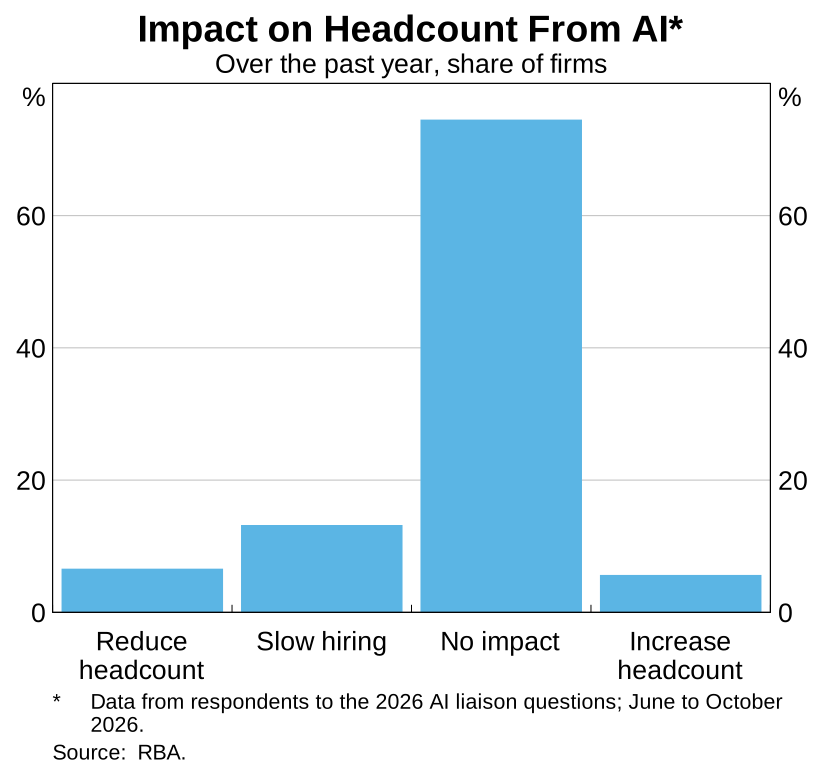
The tallest bar, by far, said “No impact.” In her speech, Hunter put it plainly: “contacts in the RBA’s liaison program indicate that AI has not yet impacted most firms’ headcount and is not expected to over the next year.”
The bar next to it is the one I keep looking at. It’s labeled “Slow hiring,” and it’s about twice as tall as the one labeled “Reduce headcount.”
The next day, Qantas said it would cut 850 corporate jobs in a deal with Accenture, with the work delivered mostly from India, and Australian unions accused companies of “AI washing,” Reuters reported. That’s the loud version of AI and jobs. Hunter’s chart is the quiet one. I think the quiet one is closer to the truth.
What the chart shows
The RBA didn’t publish the numbers behind the bars, so I measured them from the chart file the bank posted. Read that way, about 75% of responding firms said AI had no impact on headcount over the past year. About 13% said they had slowed hiring. About 7% said they had reduced headcount, and about 6% said they had increased it. [Chart: impact on headcount from AI, share of Australian firms, RBA liaison.]
Those are my readings of bar heights, rounded. HRD Australia, reading the same chart, put the two middle bars at around 12% and 8%. Either way the shape holds: slower hiring beats cuts by somewhere between three to two and two to one.
And notice what that means in plain terms. Among the firms where AI changed anything about staffing, the most common change wasn’t firing anyone. It was not hiring someone.
The bank’s data say the same thing a different way
Hunter’s speech came out the same day as a research note by RBA economist Mike Major, “Monitoring Early Effects of AI on the Labour Market.” It’s a careful piece of work, and it lines up with the liaison chart.
Major grouped Australian occupations by how closely their tasks match what AI can do, using Jobs and Skills Australia’s exposure scores. Then he compared what’s happened since November 2022, when ChatGPT came out.
The flows barely moved. “There is little evidence to date of differences in job-finding rates or employment-to-unemployment transition rates across occupations with different AI exposure,” he wrote. People in exposed jobs aren’t losing them faster, and people looking for work in those fields aren’t finding it noticeably slower.
But the stocks moved a little. Employment growth and hours worked “have been a little weaker in more AI-exposed occupations.” Job ads in the most exposed group slowed a bit more than in others. And the occupations that drove most of that slowdown in new ads were, in Major’s list, “general clerks, software and applications programmers, ICT business and systems analysts, call or contact centre workers and receptionists.”
That list is worth reading slowly, because it’s a list of entry points. Clerk, receptionist and contact center jobs are often where people start out, with or without a degree. Programming and systems analyst roles have junior levels that serve as the first rung for graduates. The tasks in those jobs are the ones today’s tools handle best: answering routine questions, moving information between systems, writing first drafts of code. When those openings get rarer, the effect isn’t a layoff count. It’s a ladder with a missing bottom rung.
It also matches what companies are saying out loud elsewhere. This week a South Korean telecom executive told investors he expects AI to cut the number of counselors at its customer centers “a lot,” and a Swedish retailer said the customer cases its AI can’t resolve will primarily go to an outside partner. I wrote about both today. Neither is Australian. Both are the kind of decision that would show up as a weaker job-ad count for contact center workers long before it shows up as unemployment.
Then the part that matters most. “Within the most AI-exposed occupations, younger workers appear to have experienced weaker employment outcomes and larger increases in unemployment than older workers, which is not the case for less AI-exposed occupations.”
Put the chart and the note together and you get one picture. Employers aren’t pushing many people out the door because of AI. They’re opening the door less often, and the people standing outside it are young.
Why hiring is the first thing to move
There’s a simple reason this is the pattern, and it has nothing to do with AI being gentle.
A firm that thinks AI might do part of a job has two choices. It can fire the person doing it now, which costs severance, morale and maybe a headline. Or it can wait until someone leaves and not post the opening, which costs nothing and is reversible if the tool disappoints. Any manager who isn’t sure yet will pick the second. Most managers aren’t sure yet.
On Monday I wrote about a Cleveland Fed study of US workers that found AI exposure looked like a door problem, not an exit problem: people in the most exposed occupations weren’t separating from jobs any faster, but they were taking longer to find the next one, and the young were hit hardest.
Australia’s central bank ran a version of the same test on a different country’s data, and the answer only partly matches. The exit side matches: no faster moves from work into unemployment in exposed jobs. The young-worker pattern matches. But the RBA found little difference in job-finding rates, which is exactly where the US study found the biggest gap. In Australia the weakness shows up earlier in the pipeline, in fewer job ads and slower employment growth.
I’d rather tell you that than pretend the two studies agree perfectly. They use different exposure measures, different surveys and different labor markets. What they share is the direction: neither finds AI pushing people out faster, and both find the young in exposed jobs doing worse. One country’s data can fool you. Two pointing the same way on the main question is harder to dismiss.
It’s also why young workers show it first. Entry-level jobs are the ones that open when somebody else moves up or moves on. If the opening doesn’t get posted, the person who doesn’t get it is usually a graduate.
The loud cuts are a different story
Now back to Qantas. The airline’s 850 roles are real job losses, and Qantas framed them as part of modernizing and speeding up its use of AI. But the work is going first to Accenture, delivered largely from India, as ABC News reported. I covered that deal on Tuesday.
Uri Gal, a professor at the University of Sydney Business School, asked the obvious question in the Reuters piece. “If AI is making these jobs redundant, why does the work first need to be transferred to another group of employees?” The Australian Services Union said the airline was “using AI to launder their cuts to Australian jobs.” Qantas told Reuters it would keep consulting unions and was focused on redeployment, and didn’t respond on the AI-washing charge. Those are claims from each side, and I’m reporting them as such.
Reuters also listed WiseTech and Atlassian as companies that cut jobs this year and attributed the losses to AI, and Telstra as having cut jobs from an AI joint venture with Accenture with some work offshored. Those companies didn’t immediately respond to Reuters.
Here’s how I’d fit that with the RBA chart. The headline layoffs are a small share of firms, about 7% by my reading, and some of what’s labeled AI in them is outsourcing with a new name. The bigger effect is the 13% that simply hired more slowly. That one never gets a press release.
The honest limits
I want to be careful here, because the RBA was careful, and it deserves credit for that.
First, the timing is terrible for clean conclusions. Australia’s unemployment rate reached 4.7% in September, a five-year high, and the RBA has raised rates five times this year, Reuters reported. When the whole economy is cooling, young workers and junior roles always get hit first. Major says outright that youth outcomes “are volatile and more cyclical than aggregate series,” and that some of the weakness since 2022 “may therefore reflect broader easing in labour market conditions rather than AI adoption.”
Second, exposure isn’t use. The exposure scores measure how much a job’s tasks resemble what AI can do, not whether anyone is actually using AI on that job. Major names this as “a key limitation.” Hunter cited Jobs and Skills Australia estimates that around 4% of Australian workers are highly exposed to automation by AI, against 31% highly exposed to AI that augments their work. “Even where AI replaces tasks, it may not replace the whole job,” she said.
Third, the liaison is a set of business conversations, not a random survey. The firms that answer the RBA’s questions aren’t necessarily typical. And “slow hiring” is a firm’s own description of its intent, which can include hiring it would have slowed anyway.
Fourth, my chart numbers are measurements of a picture. They’re accurate to about a percentage point, not better.
So this isn’t proof that AI is closing the door on young Australians. It’s evidence that if AI is doing anything to Australian jobs yet, the hiring channel is where to look.
More firms slowed hiring than cut jobs
Share of Australian firms, past year. Our reading of RBA Graph 8.
How to read thisEach bar starts at zero. Teal is slowed hiring. These shares are our reading of RBA Graph 8, rounded to the nearest whole percent.
13% vs 7%
firms that slowed hiring, against firms that cut headcount. Our reading of RBA Graph 8.
Bar chart. Use the up and down arrow keys to move through 4 categories. A data table follows.
Reduce headcount: Share of firms 7%
- Exact readings: 6.6, 13.2, 74.5 and 5.7. Drawn values are those readings rounded.
Figure 1. Rounded to the nearest whole percent. Exact readings of the bar heights are 6.6, 13.2, 74.5 and 5.7. RBA did not publish the numbers.
Source: Reserve Bank of Australia, Sarah Hunter speech, Nov 9, 2026, Graph 8. Values are our reading of the published SVG. Chart: Post Labor Economics Download CSV Methodology
Data table
Pixel readings and the source SVG measurements are in the download. The chart draws the rounded shares.
| item | Share of firms |
|---|---|
| Reduce headcount | 7% |
| Slow hiring | 13% |
| No impact | 75% |
| Increase headcount | 6% |
My read
In my opinion, the RBA chart is one of the most useful pictures of AI and jobs I’ve seen from a central bank, and the reason is that it asked the simplest question. Not “how exposed is your workforce” or “how much could AI do,” but “what did you actually do to headcount because of AI.” Most firms said nothing. Of those that did something, more held back hiring than cut.
That’s the pattern I’d expect when a technology is good enough to make managers hesitate but not good enough yet to make them sure. And it’s the pattern that hurts the people with the least voice, the ones who would have been hired.
There’s an upside worth naming too. About 6% of firms said AI led them to add staff. That’s not nothing, and it’s about the same size as the share that cut.
What to watch
Hunter said the bank will “analyse these developments closely,” and Major’s note says the RBA will keep developing its monitoring, adding adoption surveys, liaison and wage data. Australia’s October labor force figures come out Nov. 19, HRD noted. A fresh occupation-level cut, under a new classification, is due later this year.
My recommendation, for anyone running a team or planning a graduate intake: track your own version of Hunter’s chart. Every time a role opens and you decide not to fill it because of a tool, write that down as an AI decision. It’s the one most firms don’t count, and in Australia it’s the most common one.
Chart note: Impact on headcount from AI over the past year, share of responding Australian firms. Universe: respondents to the RBA’s 2026 AI liaison questions, June to October 2026. Values are our reading of bar heights in the RBA’s published Graph 8, rounded to whole percent (RBA did not publish the numbers). Source: Reserve Bank of Australia, Hunter speech, Nov 9, 2026. CSV: rba-liaison-ai-headcount-2026.csv; source SVG saved as rba-graph08-source.svg.
Sources
- Reserve Bank of Australia, Sarah Hunter, Assistant Governor (Economic), “What Happens to the Economy as ‘Intelligence’ Gets Cheaper?”, UBS Australasia Conference, Sydney, Nov 9, 2026. https://www.rba.gov.au/speeches/2026/sp-ag-2026-11-09.html (liaison quote; Graph 8, “Impact on Headcount From AI,” respondents June to October 2026; JSA 4% and 31%; “Even where AI replaces tasks…”; “analyse these developments closely”).
- Reserve Bank of Australia, Graph 8 SVG. https://www.rba.gov.au/speeches/2026/images/sp-ag-2026-11-09-graph08.svg (bar geometry used for our readings).
- Reserve Bank of Australia, Mike Major, “Monitoring Early Effects of AI on the Labour Market,” RBA Insight 2026-09, Nov 9, 2026. https://www.rba.gov.au/publications/insights/australian-economy/2026/monitoring-early-effects-of-ai-on-the-labour-market.html (flows quote; stocks quote; occupations list; young-worker quote; youth volatility and easing quotes; “a key limitation”).
- Reuters (via Investing.com), Renju Jose and Christine Chen, “Australian companies face ‘AI washing’ claims after wave of job cuts, offshoring,” Nov 12, 2026 (published 4:01 p.m. ET Nov 11). https://www.investing.com/news/economy-news/australian-companies-face-ai-washing-claims-after-wave-of-job-cuts-offshoring-5019845 (Qantas 850; Gal quote; ASU quote; Qantas response; WiseTech, Atlassian, Telstra; unemployment 4.7% five-year high; five rate rises).
- ABC News, Kristy Sexton-McGrath, “Qantas lay-offs show tourism industry grappling with influence of AI,” Nov 11, 2026. https://www.abc.net.au/news/2026-11-11/qantas-layoffs-tourism-ai/107368252 (work delivered predominantly from India; Hudson framing).
- HRD Australia, Stephen Owens, “Graduate hiring and AI: RBA spots early warning signs for young workers,” Nov 9, 2026. https://www.hcamag.com/au/news/general/graduate-hiring-and-ai-rba-spots-early-warning-signs-for-young-workers/596590 (independent chart reading: around 12% and about 8%; October labour force release Nov 19).
- Post Labor Economics, earlier pieces: https://postlaboreconomics.com/posts/ai-exposed-workers-the-door-not-the-exit/ ; https://postlaboreconomics.com/posts/qantas-offshore-first-ai-later/
Derived values (our arithmetic): bar heights 32.76, 65.52, 369.71, 28.08 px at 4.96 px per percentage point = 6.6%, 13.2%, 74.5%, 5.7% (sum 100.0%); slow hiring / reduce = 2.0 (our reading) or 1.5 (HRD’s reading).