
AI Labor Tracker
Microsoft's Headcount Barely Moved. Its Revenue Rose 67%
Microsoft's sales rose 67% from fiscal 2022 to fiscal 2026 while its workforce barely moved. The filings show that flat number hid a lot of people leaving, and now 60,000 more have an exit offer.
+0.9%
Change in Microsoft's headcount from June 30, 2022 to June 30, 2026, while revenue rose 67% (Microsoft 10‑K filings)
Shawn Mrzena’s last day at Microsoft was July 2, The Economic Times reported. He’d been there about 25 years, starting as an enterprise account executive and finishing as a director in AI business solutions, according to the Hindustan Times.
He left through Microsoft’s first voluntary retirement program. In June, GeekWire described him as trading the AI firehose for a welding torch. He planned to go to school for welding and metal fabrication.
“I love the trades,” he said, “because I can feel it and touch it.”
Ninety days later he posted photos of himself raising beams, fixing plumbing under a trailer and guiding fly fishing trips. “Corporate life taught me a lot. These last 90 days taught me even more,” he wrote, as The Economic Times reported.
Mrzena chose to go, and he sounds happy about it. That makes him one of the lucky ones in a company whose workforce has been reshuffled hard while its total headcount stood still.
On the All-In podcast on Oct. 30, one of the hosts put that standstill in one line.
“Microsoft’s revenue went from 198 billion to 332 billion in the last 4 years while staff only increased by 2,000 people. I mean, isn’t that stunning?”
It is stunning. It’s also correct. But the conclusion the host drew from it, that this isn’t really a story about lost jobs, doesn’t hold up once you read past the totals.
What the filings actually show
Microsoft reports revenue and headcount once a year in its annual 10‑K filing, with its fiscal year ending June 30.
In fiscal 2022, revenue was $198.3 billion and the company had 221,000 employees.
In fiscal 2026, revenue was $331.8 billion and it had 223,000 employees, per the fiscal 2026 10‑K.
So the host’s numbers check out. Revenue rose 67%. Headcount rose about 1%.
Microsoft's revenue rose 67% from fiscal 2022 to 2026; its headcount rose 0.9%
Index, fiscal 2022 = 100
+0.9%
Change in Microsoft's headcount, June 30, 2022 to June 30, 2026.
Line chart. Use the left and right arrow keys to move through 5 periods. A data table follows.
FY2026: Revenue index 167.4, Staff index 100.9
- FY2026: headcount falls 5,000 from FY2025
- Revenue $198.3B to $331.8B
Figure 1. Microsoft revenue and employees, fiscal 2022 to fiscal 2026, indexed so fiscal 2022 = 100.
Sources: Microsoft Form 10‑K filings, fiscal 2022 to fiscal 2026, SEC EDGAR. Chart: Post Labor Economics Download CSV Methodology
Data table
Fiscal years end June 30. Revenue in nominal dollars: $198.3B (FY2022) to $331.8B (FY2026). Employees are full-time staff on June 30 as reported in each 10‑K: 221,000 (FY2022 and FY2023), 228,000 (FY2024 and FY2025), 223,000 (FY2026). Headcount is a snapshot and does not show hires and departures during the year.
| fiscal_year | Revenue index | Staff index |
|---|---|---|
| FY2022 | 100.0 | 100.0 |
| FY2023 | 106.9 | 100.0 |
| FY2024 | 123.6 | 103.2 |
| FY2025 | 142.1 | 103.2 |
| FY2026 | 167.4 | 100.9 |
That works out to about $1.49 million in revenue per employee in fiscal 2026, up from about $897,000 in fiscal 2022.
Put another way, each person on the payroll in fiscal 2026 was attached to about two-thirds (66%) more sales than in fiscal 2022.
The split is worth a look. The US workforce went from 122,000 in fiscal 2022 to 121,000 in fiscal 2026.
The international side grew from 99,000 in fiscal 2022 to 102,000 in fiscal 2026. So every bit of the net gain happened outside the US.
By function, operations and research and development grew from fiscal 2022 to fiscal 2026. Sales and marketing shrank, from 47,000 people to 43,000.
And the trend has turned down. Headcount fell by 5,000 between June 2025 and June 2026, and Microsoft’s latest quarterly filing, for the three months to Sept. 30, 2026, says “total company headcount decreased 2%” compared with Sept. 30, 2025, per the 10‑Q.
Who left while the total held still
Here’s the part the totals hide. A headcount is a photo taken on June 30. It doesn’t show who walked out the door and who replaced them.
Microsoft cut roughly 15,000 jobs in 2025, which we covered in an earlier piece.
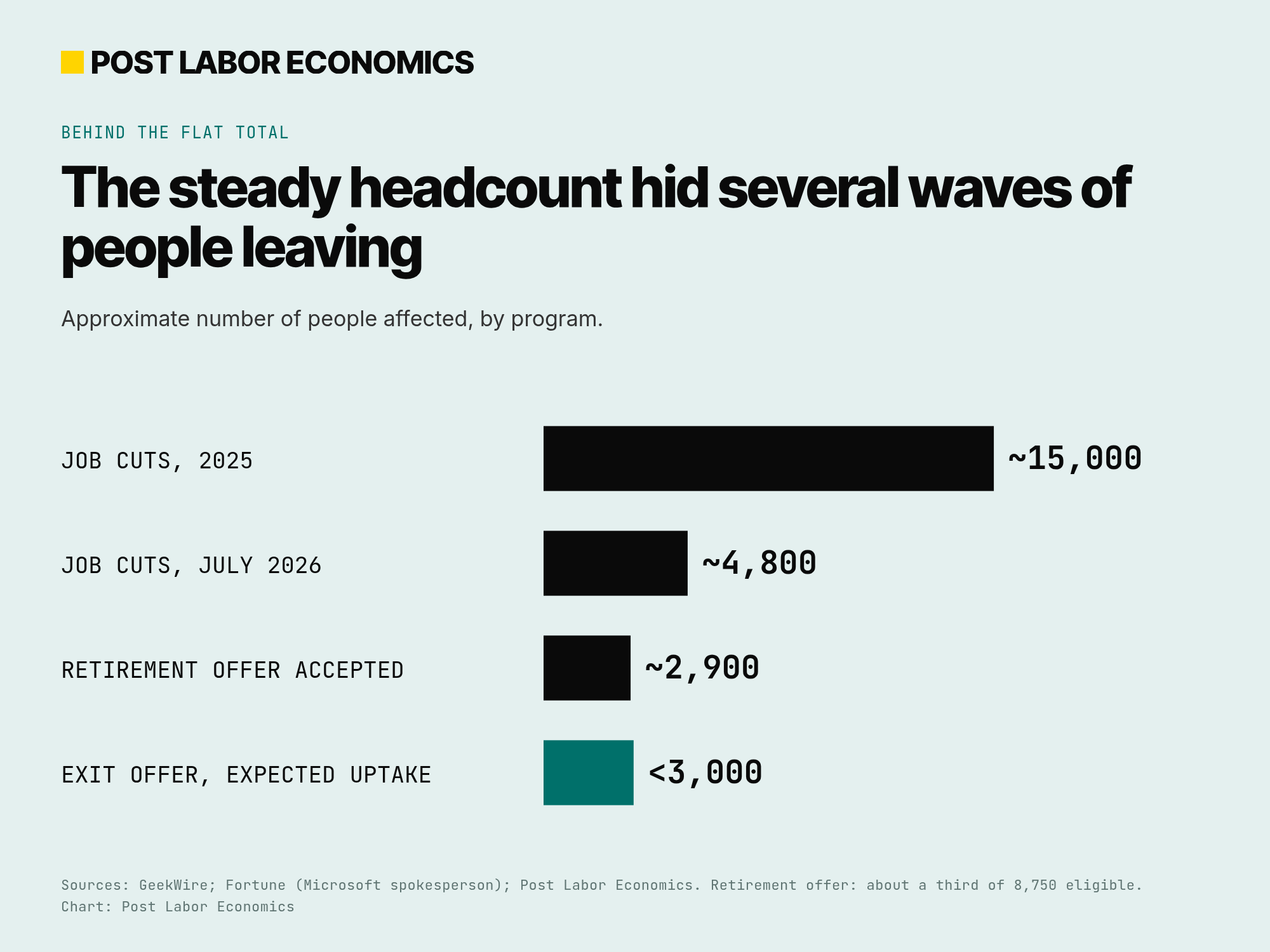
In July 2026 it cut about 4,800 more, about 2% of its workforce, GeekWire reported. The Xbox division alone was losing about 3,200 jobs over the fiscal year, and the sales force was reorganized.
Before that came the retirement program Mrzena took. About 8,750 US employees were eligible, and roughly a third accepted, per GeekWire.
To qualify, your age plus your years of service had to add up to at least 70. The package paid up to about 39 weeks of salary and covered health insurance for the first year, after which people moved to COBRA. GeekWire noted that people taking it generally can’t collect unemployment.
So the people leaving included a lot of veterans with decades of experience, and the people arriving were whoever Microsoft decided to hire for the next phase.
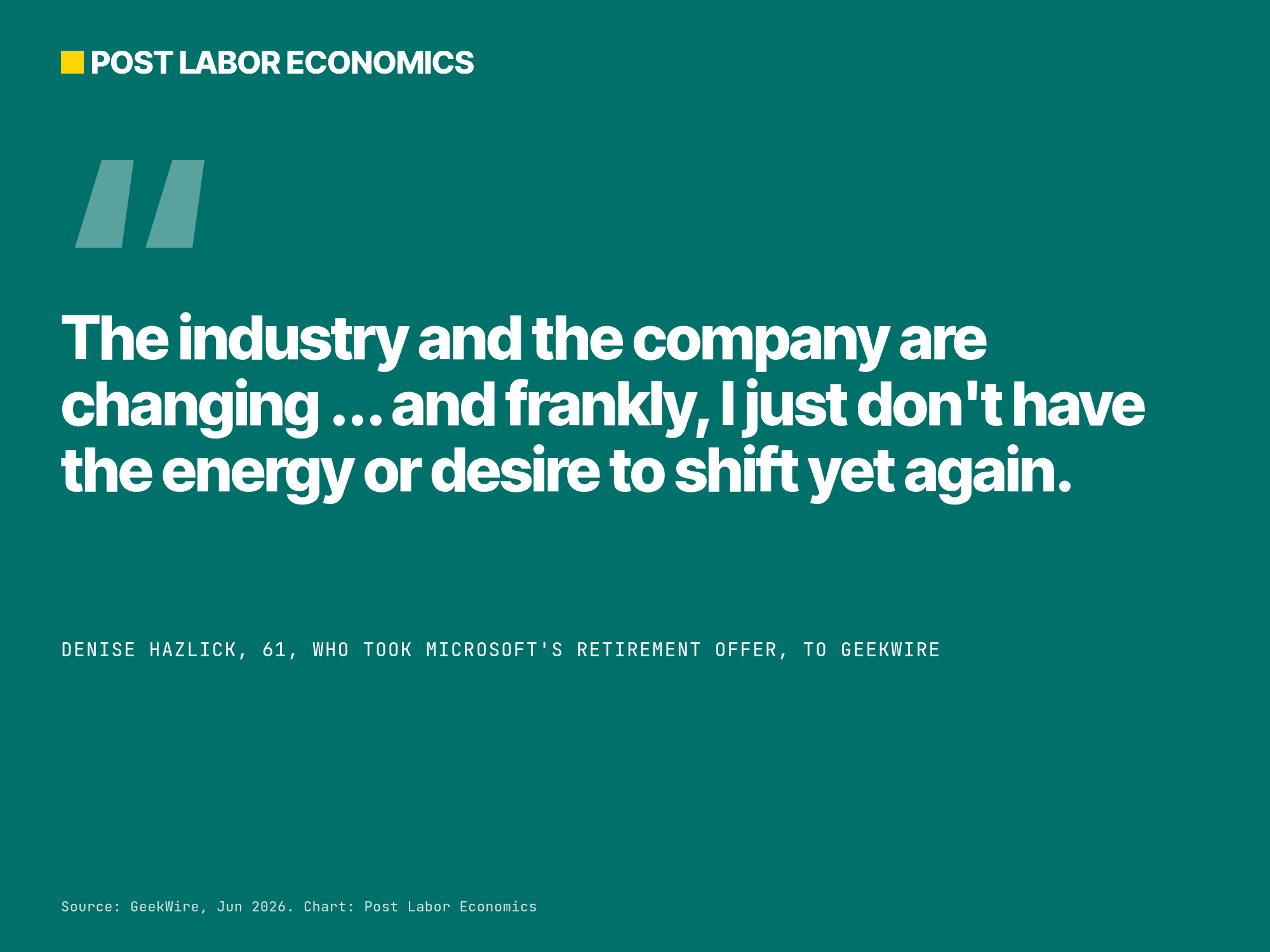
Denise Hazlick, 61, was one of the veterans who took the retirement offer. “The industry and the company are changing … and frankly, I just don’t have the energy or desire to shift yet again,” she told GeekWire.
Others framed it as a chance. James Whelan, 49, said he wanted to “control my own destiny.” Aileen Hannah put it this way: “Microsoft is releasing me back into the wild.”
Scott Thurlow, another of the veterans GeekWire interviewed, is pursuing a doctorate on how to keep humans overseeing engineering work as AI takes on more of it. That’s a pretty good summary of the question hanging over everyone who stayed.
Joseph Phillips, a Seattle University professor, put the pattern plainly to Fortune: “they have been hiring while they have been laying people off.”
The host’s next point on the podcast was that flat headcount shows AI isn’t killing jobs. “This idea that it creates job loss, I don’t think it’s true,” one of the hosts said. “It’s more that you’re seeing productivity gains at the same number of human input.”
Two problems. First, tens of thousands of specific people lost specific jobs while the total held steady.
Second, “the same number of human input” leaves out the machines. Microsoft’s capital spending went from $23.9 billion in fiscal 2022 to $115.9 billion in fiscal 2026, per its 10‑Ks.
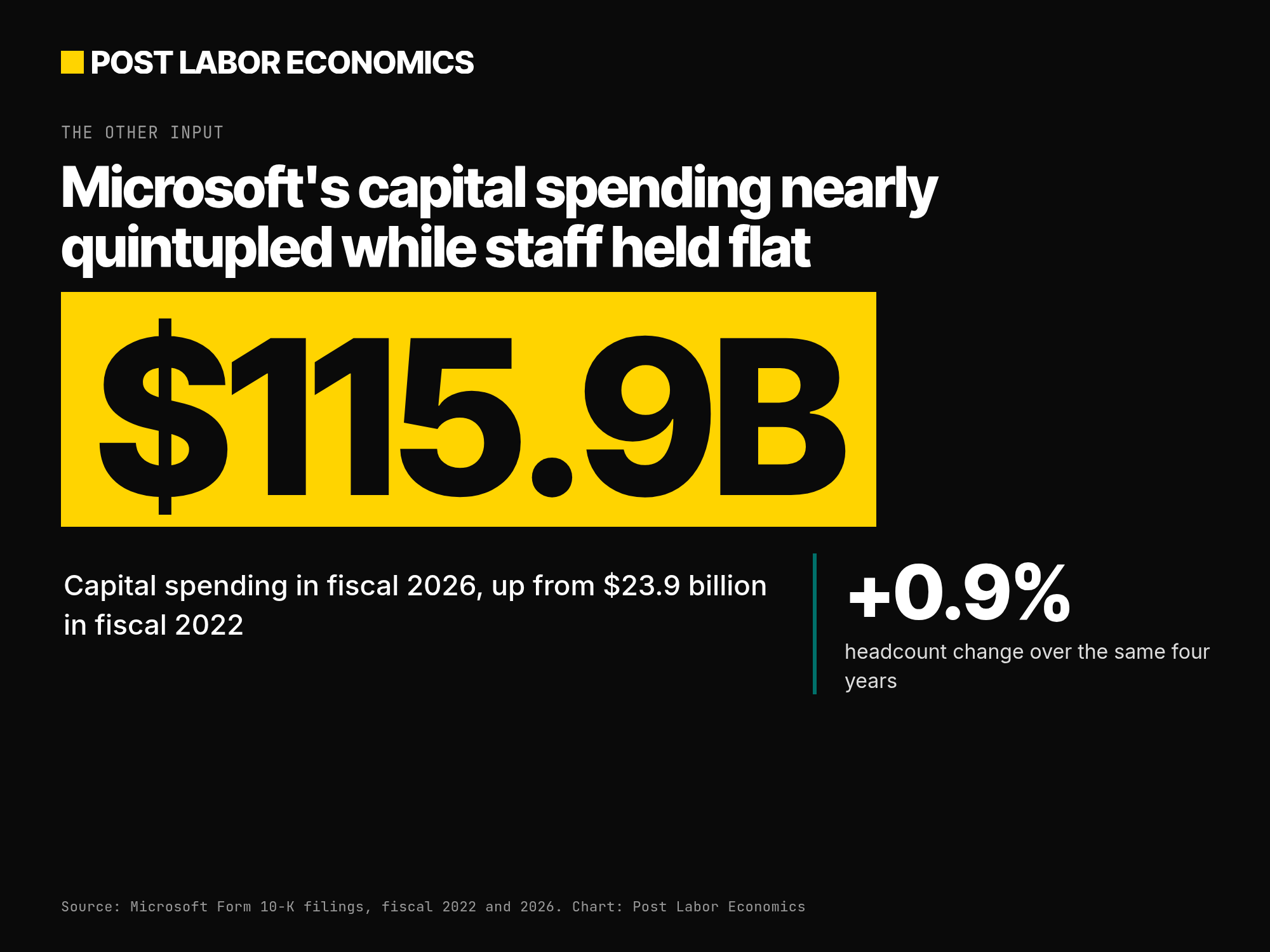
That’s almost five times as much. A good chunk of that extra revenue per worker was bought with data centers and chips.
Microsoft itself is careful here. When it announced the July cuts, chief people officer Amy Coleman wrote in a July 6 memo that “the roles eliminated today are not being replaced by AI,” while adding that “AI is changing how work gets done.” I’d call that technically true and not very comforting.
Coleman also said, “We are still early on this journey, and there will be more changes ahead.” In late October came the exit offer.
The July cuts were spread around. About 600 were in Washington state, where Microsoft’s local workforce of roughly 52,000 has held fairly steady, GeekWire reported. More than 4,000 employees were also moved into new roles, the company said.
How the other giants compare
Here’s the comparison that matters. Microsoft isn’t unusual. I pulled the same two numbers, revenue and employees, from the annual filings of three other large US tech companies and Europe’s biggest software company for 2022 and 2025.
Every one of them grew revenue much faster than staff. Meta stood out. Its headcount fell 9% from 2022 to 2025 while revenue per employee nearly doubled.
Revenue per employee rose at all five large tech companies from 2022 to 2025; Meta's rose 89%
Percent change in revenue per employee, 2022 to 2025
89%
Rise in Meta's revenue per employee from 2022 to 2025, even as its workforce shrank.
Bar chart. Use the up and down arrow keys to move through 5 categories. A data table follows.
Meta: Change 89.0%
- Meta headcount fell 9% from 2022 to 2025
- SAP: Europe's biggest software company
Figure 2. Change in revenue per employee, 2022 to 2025. Microsoft uses fiscal years ending June 30.
Sources: Form 10‑K filings for Microsoft, Alphabet, Meta and Amazon; SAP Form 20‑F, SEC EDGAR. Chart: Post Labor Economics Download CSV Methodology
Data table
Revenue divided by year-end employees as reported in each company's annual filing. Microsoft is fiscal 2022 to fiscal 2025 so all five cover three years; fiscal 2022 to 2026 it rose 66%. Amazon counts full- and part-time staff (about 1.54M and 1.58M). SAP reports revenue in euros and staff as full-time equivalents; its 2022 figures are restated to exclude Qualtrics, sold in 2023. Headcount change: Meta −8.8%, Alphabet +0.3%, Amazon +2.3%, Microsoft +3.2%, SAP +4.1%.
| company | Change |
|---|---|
| Meta | 89.0% |
| Alphabet | 42.0% |
| Microsoft | 37.7% |
| Amazon | 36.4% |
| SAP | 19.8% |
Microsoft’s bar covers fiscal 2022 to fiscal 2025, a 38% rise, so it spans the same three years as the others. Measured from fiscal 2022 to fiscal 2026, the rise is 66%.
Alphabet ended 2025 with 190,820 employees, almost exactly its 2022 count, on revenue of $403 billion.
By Sept. 30, 2026, the two had split. Alphabet’s latest quarterly filing shows staff back up to 204,757 as of Sept. 30, 2026.
Meta’s latest filing shows the opposite. Its headcount on Sept. 30, 2026 was down 15% from Sept. 30, 2025.
SAP is the international check. The German company had 106,312 full-time-equivalent staff at the end of 2022, restated to exclude Qualtrics, which it sold in 2023, per its 2023 20‑F. It had 110,650 at the end of 2025, per its 2025 20‑F.
Revenue rose 25% from 2022 to 2025, from €29.5 billion to €36.8 billion, so revenue per employee rose about 20%.
SAP’s 2024 restructuring covered about 10,000 positions, mostly handled through voluntary leave and reskilling programs, the company said. That’s the same playbook Microsoft is now running at much bigger scale.
The 60,000 and the under-200,000 guess
On Oct. 26, Microsoft announced a voluntary exit offer for eligible employees at level 70 and below in participating teams in the US, Canada, the UK and India. Coleman described it as giving people “who may be considering a future outside the company a new choice to make that transition now with support,” in a company blog post.
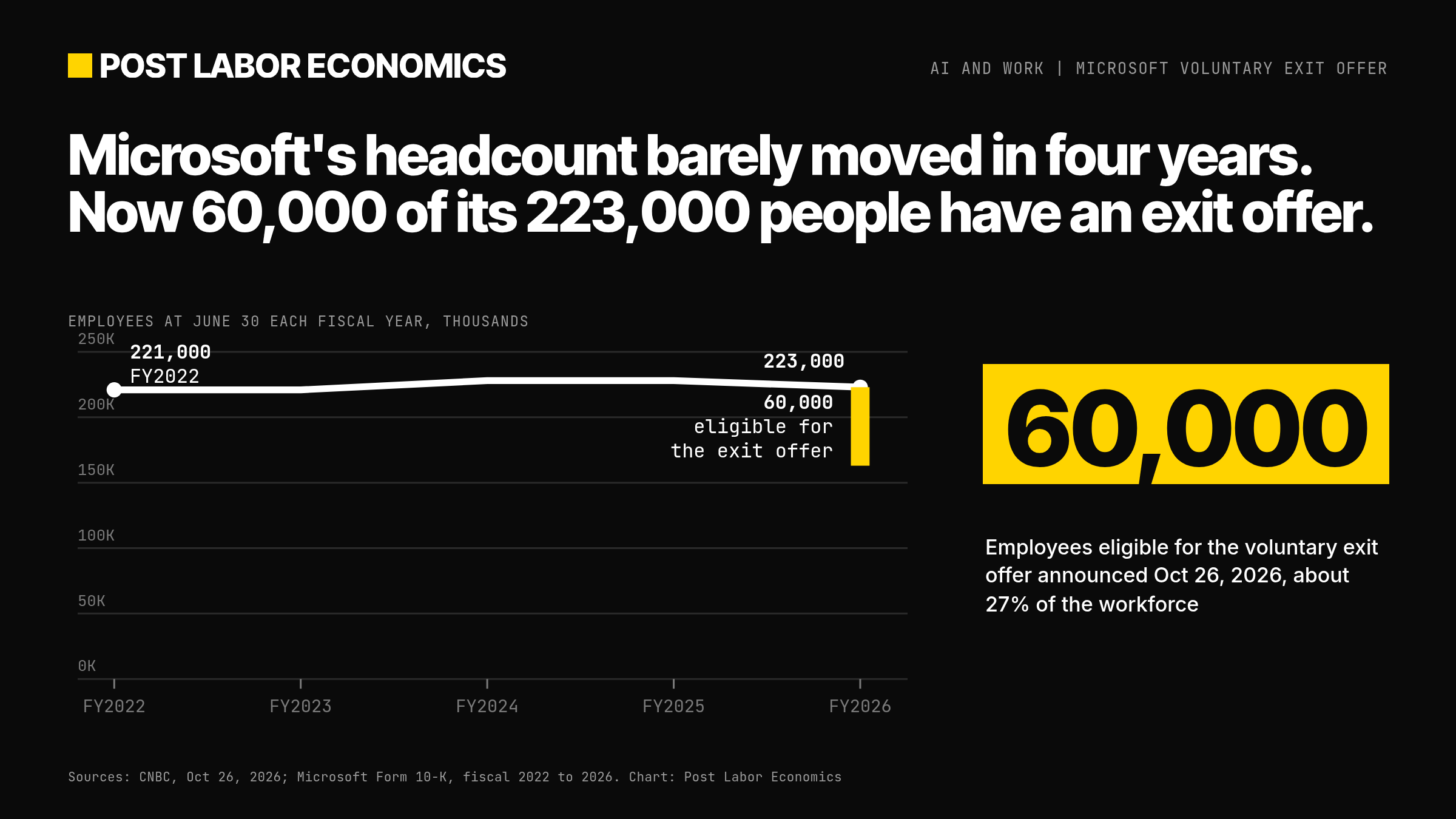
CNBC reported that about 60,000 people are eligible, roughly 27% of the workforce. They decide in early December, and those who accept leave Dec. 31.
So the host’s 60,000 is right. The second half of that remark is where it gets shaky. “This number could be under 200,000 depending on how many take it,” one of the hosts said.
To get under 200,000, more than 23,000 people would have to leave, based on the June 30 count of 223,000 and assuming no new hiring. That’s about 38% of everyone eligible.
A Microsoft spokesperson told Fortune, “we anticipate an under 5% uptake on the 60,000 employees that are eligible for the program.” That would be fewer than 3,000 people.
Under 200,000 isn’t impossible if layoffs follow. But it isn’t what the company expects from this offer, and we won’t know until the filings say so.
The 10‑Q for the quarter ending Dec. 31, 2026 should be out in late January 2027, and the next headcount in the fiscal 2027 10‑K, around the end of July 2027.
Jay Zagorsky of Boston University read the offer more bluntly than Microsoft did. “Microsoft’s announcement is a clear indication they want fewer workers,” he told Fortune.
Who gets in now
The flat total also hides a door that’s narrowing for people trying to get in.
Software development postings on Indeed in the US peaked on Feb. 28, 2022, at 2.34 times their February 2020 level.
By Oct. 23, 2026, they were about 19% below where they stood in February 2020, and 65% below that peak, per Indeed Hiring Lab data on FRED.
For recent college graduates, the New York Fed’s tracker put unemployment at 5.2% in the third quarter of 2026, with 42.5% working jobs that don’t need their degree, per its college labor market page.
That’s not all Microsoft’s doing, of course. But the biggest employers in the industry are all running the same math, and the result for a new grad is fewer openings at the top of the funnel.
It also changes who an exit offer helps. For a veteran close to retirement, a package can be a bridge. For someone early in a career, the same deal leads straight into the job market those numbers describe.
Microsoft has said where it wants people. On July 2 it announced Microsoft Frontier Company, a $2.5 billion unit that embeds about 6,000 industry and engineering experts with customers.
President and vice chair Brad Smith told GeekWire in July that “some things like coding require less time of software developers,” while product management, software design and “working directly with customers” are growing.
My read: Microsoft’s workforce didn’t stay flat because AI spared it. It stayed flat because the company swapped out a lot of experienced people in sales and older product lines for people in AI, data centers and customer-facing engineering, while spending five times as much on data centers and equipment. The total is the least interesting number in the filing.
What I’d do
Mrzena says he’ll decide in 2027 whether to learn a trade, start something or work part time. He got to leave on his own schedule, with a package, after a long career. Not everyone in the 60,000 will feel that way, and the people trying to get hired don’t get a package at all.
If you’re trying to get into a company like this, or stay at one, aim your next year at the work Microsoft says is growing: technical jobs that sit directly with customers and help them put AI to use. Build one real project that shows you can do that, and lead with it. The company is putting its new engineers there, and Smith’s own description of where the jobs are pointed the same way.
That’s not a guarantee. But it’s a better bet than competing for the shrinking pile of jobs that only ask you to write code.