
AI Labor Tracker
Goldman Finds AI-Displaced Workers Stay Out of Work Longer
A new Goldman Sachs analysis finds workers laid off from AI-exposed jobs take about a month longer to find work, and the gap is wider after 35. One engineer's search shows what that month feels like when it stretches into a year.
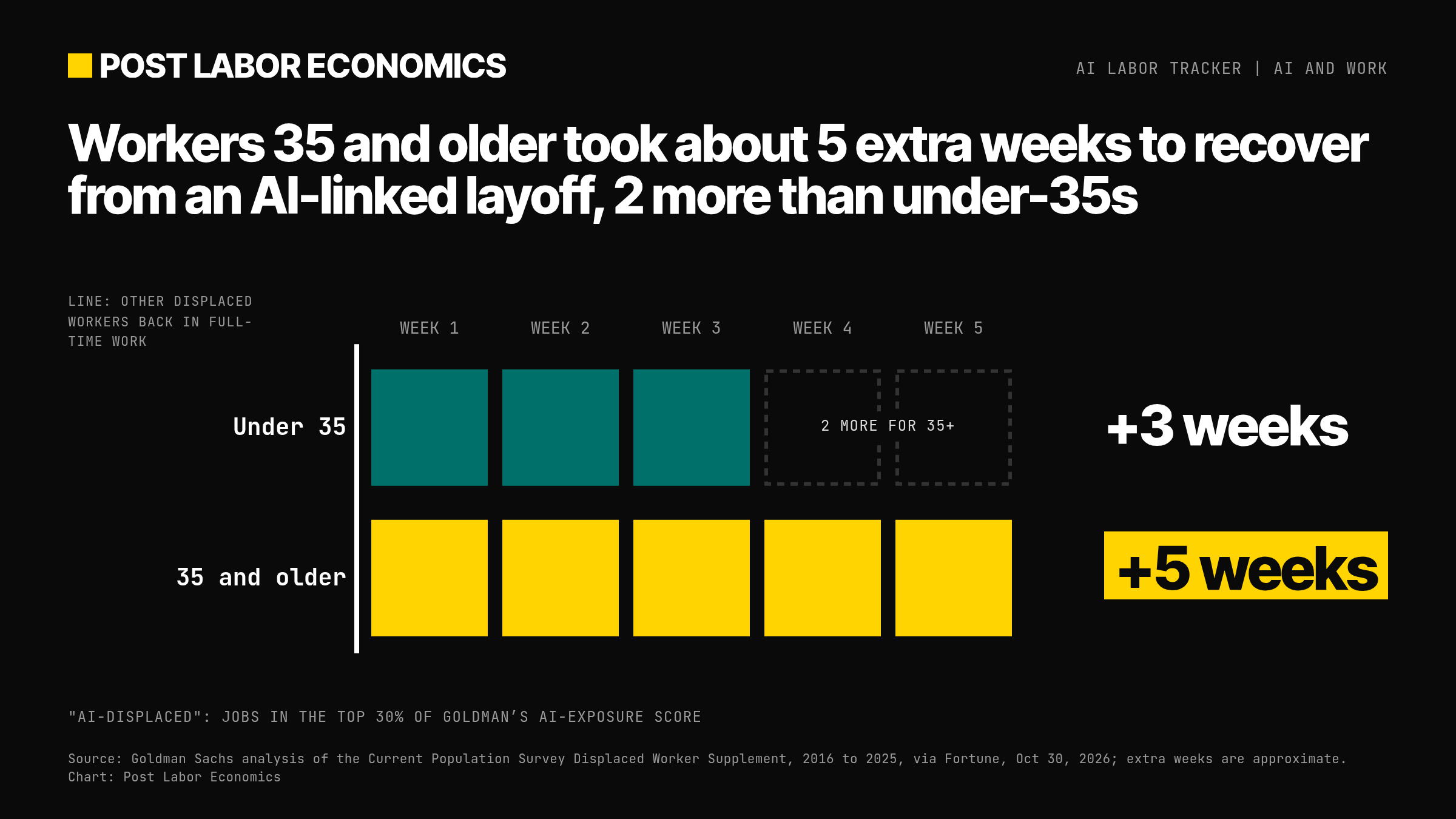
5 weeks
How much longer AI-displaced workers 35 and older took to get back to full-time work than other displaced workers (Goldman Sachs via Fortune, Oct 30, 2026)
In April 2024, a software engineer who goes by Shawn K lost a job that paid about $150,000 a year. He’d been laid off twice before, after the 2008 financial crisis and again during the pandemic, and both times he was working again within a few months, Fortune reported.
This time he sent out about 800 applications in a year and landed fewer than 10 interviews. Some of those interviews were with an AI agent instead of a person.
“I feel super invisible,” he told Fortune. “I feel unseen. I feel like I’m filtered out before a human is even in the chain.”
He tried lowering the bar. In his essay, he wrote that after six months he was applying for anything he could do, including WordPress theme jobs paying less than half of what he was worth, and still heard nothing.
He was 42. He was living in a small RV trailer in central New York, delivering DoorDash orders and selling old things on eBay to cover a fraction of what he used to earn.
What Goldman found
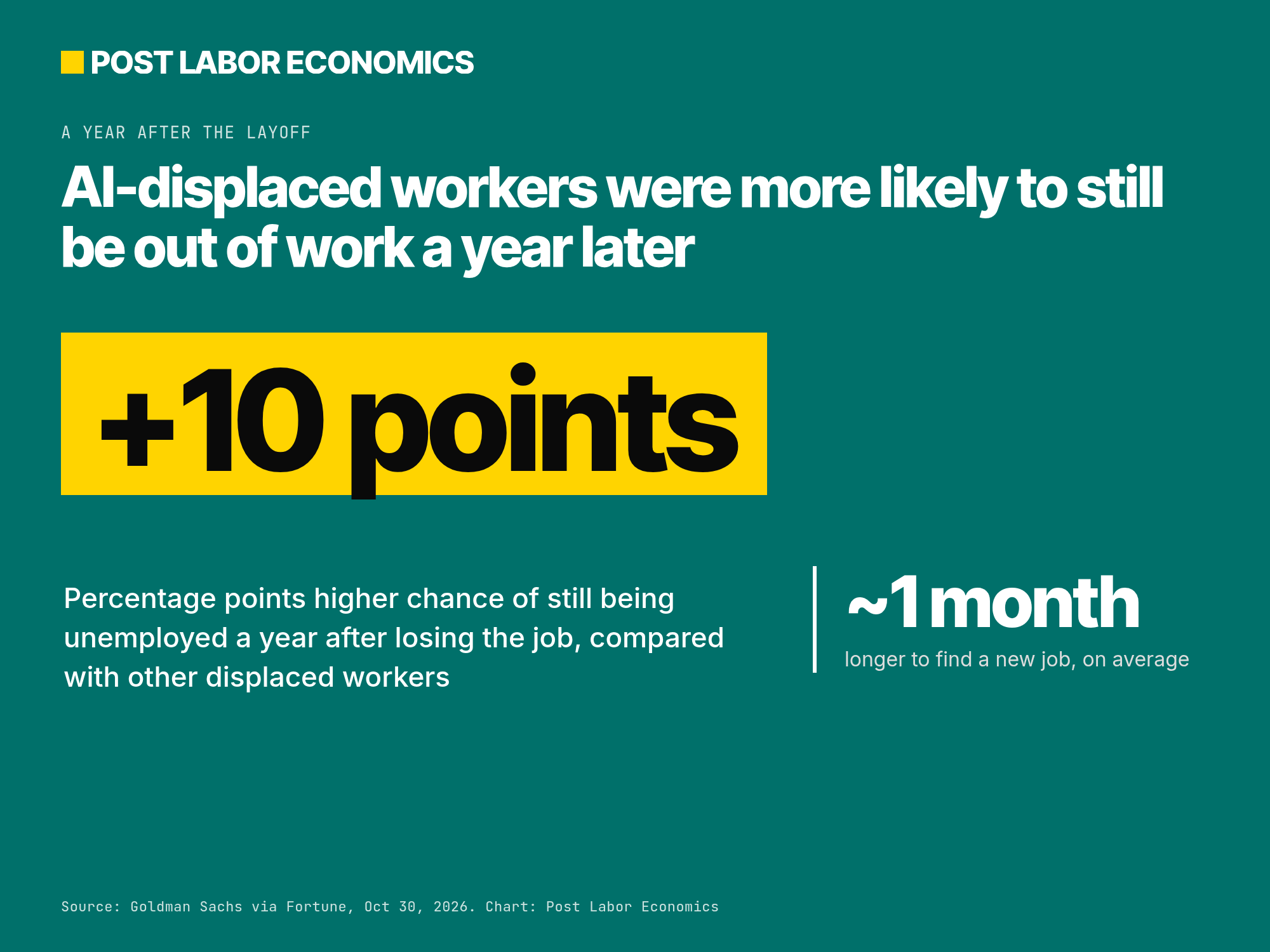
Last Thursday, Goldman Sachs economist Pierfrancesco Mei put numbers on what Shawn K described. Workers displaced from AI-exposed jobs since 2025 took about a month longer to find a new job than other laid-off workers, Fortune reported on October 30.
They were also about 10 percentage points more likely to still be unemployed a year after losing their job. Mei wrote that those effects are “comparable in magnitude” to earlier waves of technological change, and he called the damage from those waves “long-lasting.”
Age made the gap bigger.
After an AI-linked layoff, workers 35 and older took about 5 extra weeks to recover, 2 more than under-35s
Extra weeks to get back to full-time work, compared with other displaced workers
5 weeks
Extra weeks AI-displaced workers 35 and older took to get back to full-time work.
Bar chart. Use the up and down arrow keys to move through 2 categories. A data table follows.
Under 35: Extra weeks 3
- Younger AI-displaced workers lost about 3 extra weeks
Figure 1. Extra weeks AI-displaced workers took to return to full-time work versus other displaced workers, by age. Goldman's approximate figures.
Source: Goldman Sachs note, Oct 29, 2026, via Fortune, Oct 30, 2026. Chart: Post Labor Economics Download CSV Methodology
Data table
Goldman gave "about five weeks" and "about three weeks." "AI-displaced" means the top 30% of a Goldman score built from occupation AI exposure, industry AI adoption and whether the position was eliminated; no survey asks whether AI caused a job loss.
| group | Extra weeks |
|---|---|
| Under 35 | 3 |
| 35 and older | 5 |
AI-displaced workers 35 and older took about five weeks longer than other displaced workers to get back to full-time work. For those under 35, it was about three weeks.
Younger workers also cycled through fewer temporary jobs on the way back. Mei wrote that they “may be able to adapt more flexibly to AI disruption.”
The layoffs themselves are piling up. Employers cited AI in 120,136 announced job cuts through September, about 21% of all cuts and the top reason given, according to Challenger, Gray & Christmas data cited by Fortune.
Younger workers are getting hit at a different point. Stanford’s Digital Economy Lab found that employment for 22- to 25-year-olds in the most AI-exposed occupations is about 19% below where it would be had it kept pace with less-exposed jobs.
The Stanford researchers wrote that the adjustment “appears to operate primarily through reduced hiring of young workers rather than increased separations.” So the young are mostly losing chances at a first job, and older workers are losing the jobs they already had.
That makes Goldman’s age finding more worrying. An older worker who loses a job has to compete for a shrinking set of openings, against younger applicants who are also struggling to get in.
The caveat that matters most
Nobody in Goldman’s data said, “AI took my job.” The survey Goldman used doesn’t ask.
So Goldman built a score. It combined how exposed a worker’s occupation is to AI, how fast their industry is adopting it, and whether their position was eliminated, then treated the top 30% as likely AI-displaced.
That’s a reasonable approach, and it has a check built in. Goldman found no significant gap between the two groups for job losses before 2023, the year AI adoption started rising.
But it means the “AI-displaced” group is a statistical stand-in. Some of those workers lost jobs for reasons that had nothing to do with AI, and some workers outside the group lost jobs because of it.
Shawn K’s case shows the same problem. His last employer was focused on the metaverse, and he blames AI for a market that stopped seeing him.
That’s his account, and nobody can prove or disprove it from the outside. He also lost his job in 2024, a year before the AI-exposed group Goldman tracked.
The sample is also modest. Goldman analyzed more than 15,000 displaced workers who lost jobs between 2016 and 2025, and only the newest slice, 2023 to 2025, is likely to include the first wave of AI-linked losses. Mei himself called it “still too early to assess the impact along all of these dimensions.”
How typical is a year-long search?
Shawn K’s search was far longer than average. Goldman’s gap is about a month, and about two in three laid-off workers are back at work within a couple of years.
The Bureau of Labor Statistics’ displaced worker survey found that 66.1% of long-tenured workers who lost jobs from 2023 to 2025 were working again by January 2026. That’s roughly the same as two years earlier.
So the typical laid-off worker isn’t living in a trailer. What’s changed is the quality of the landing, and the age at which the landing gets harder.
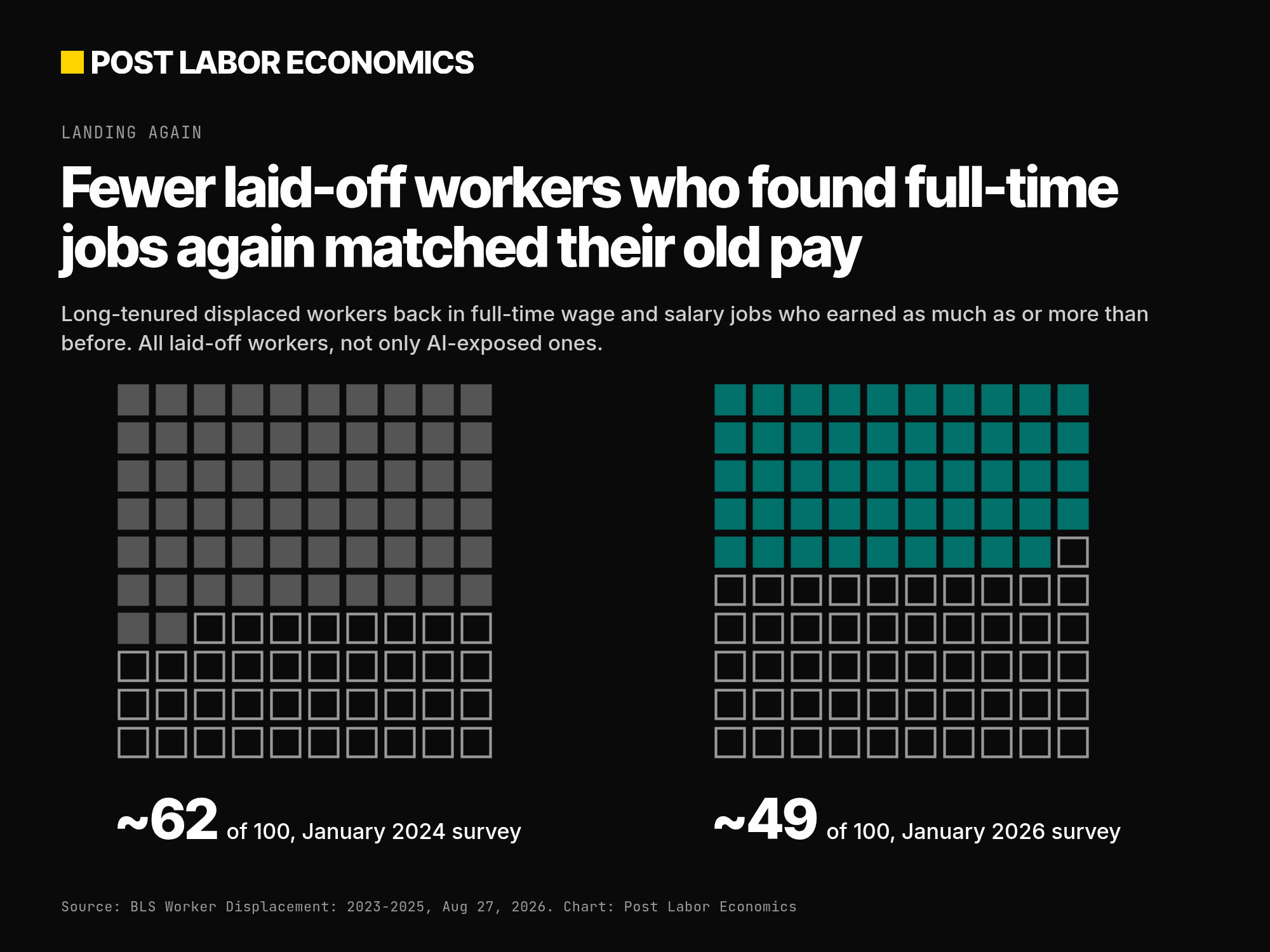
Among long-tenured workers who lost full-time jobs and found full-time work again, about 49% were earning as much as or more than before. In the prior survey it was about 62%.
The age gap in the government’s numbers is wide. Among long-tenured workers in their prime working years, 72.9% were reemployed.
For those in the decade before typical retirement age, the rate was 57.3%.
Shawn K was 42, squarely in the middle group. But in his own telling, age came up anyway.
He wrote that interviewers sometimes dismissed him once they learned “my dinosaur age of 42,” in a Substack essay that he has since taken down. Goldman’s finding that the gap widens after 35 suggests he wasn’t imagining it.
What the last waves of technology did
Goldman has looked at this before. Its earlier research, using individual records back to 1979, found that workers who lost jobs to technology saw their real earnings grow more slowly for years afterward than other displaced workers did, according to Fortune.
Their odds of another spell of unemployment also stayed higher. Younger, college-educated and urban workers had cumulative earnings losses about half as large as other technology-displaced workers over the following decade.
The same pattern shows up much further back. When AT&T replaced telephone operators with mechanical switching between 1920 and 1940, the next generation of young women found other work, as I wrote in Bigger Than the Industrial Revolution?
The operators who already had the job fared worse. A decade later, they were more likely to be in lower-paying occupations or not working at all, economists James Feigenbaum and Daniel Gross found.
That’s the hard lesson from every wave so far. The economy adjusts, and the people already in the job pay for the adjustment.
My read: the extra month in Goldman’s data matters less than the 10-point gap a year out. A month is a rough patch; a year without work is where savings, skills and confidence start to go, and that’s where older workers are getting stuck.
Shawn K is what that gap looks like up close. He lost his job in April 2024, and when Fortune interviewed him more than a year later, he still hadn’t found full-time work in his field.
His two earlier layoffs, after 2008 and during the pandemic, had each ended within a few months. This one ran past the one-year mark that Goldman measures.
How other countries compare
There’s no international version of Goldman’s AI score. The best consistent comparison of how fast laid-off workers get back to work comes from an OECD study of displaced workers in 14 countries, using data from 2000 to 2008.
Even that one comes with a warning label. The OECD said definitions and methods differed across countries and that comparisons “should be made with caution.”
Within a year of losing a job, about 89% of displaced workers in Sweden were working again, according to the OECD’s figures. In France, it was about 28%.
The US numbers depend on the measure. About 58% of Americans who reported losing a job were working within a year, while employer records showed about 72%.
What held everywhere was the age gap.
In every country the OECD studied, laid-off workers 55 to 64 got back to work less often
Re-employment rate at ages 55 to 64, as a share of the rate at ages 35 to 44 (35 to 44 = 100)
88
In the US, 88 laid-off workers 55 to 64 got back to work for every 100 aged 35 to 44.
Bar chart. 14 categories are plotted: New Zealand, United States, Sweden, Russian Federation, Canada, Finland, United Kingdom, Japan, Denmark, Australia, Portugal, Korea, Germany, France. China and India are not covered. Use the up and down arrow keys to move through 14 categories. A data table follows.
New Zealand: Re-employment index 94
- In France, only 26, about a quarter of the younger rate
Figure 2. Re-employment rate of laid-off workers aged 55 to 64 for every 100 re-employed workers aged 35 to 44, 2000 to 2008 averages (OECD).
Source: OECD Employment Outlook 2013, Figure 4.4 Panel C. Chart: Post Labor Economics Download CSV Methodology
Data table
Some countries identify displacement from employer records and others from workers' own reports, so the OECD advises caution in comparing levels. The UK figure covers the whole period to 2010. China and India were not part of the study, and I found no comparable data for either.
| country | Re-employment index |
|---|---|
| New Zealand | 94 |
| United States | 88 |
| Sweden | 87 |
| Russian Federation | 84 |
| Canada | 78 |
| Finland | 77 |
| United Kingdom | 69 |
| Japan | 68 |
| Denmark | 66 |
| Australia | 65 |
| Portugal | 52 |
| Korea | 50 |
| Germany | 36 |
| France | 26 |
In all 14 countries in the age comparison, older displaced workers were less likely to be working again than prime-age ones, according to the OECD’s age data. The US gap was among the smallest.
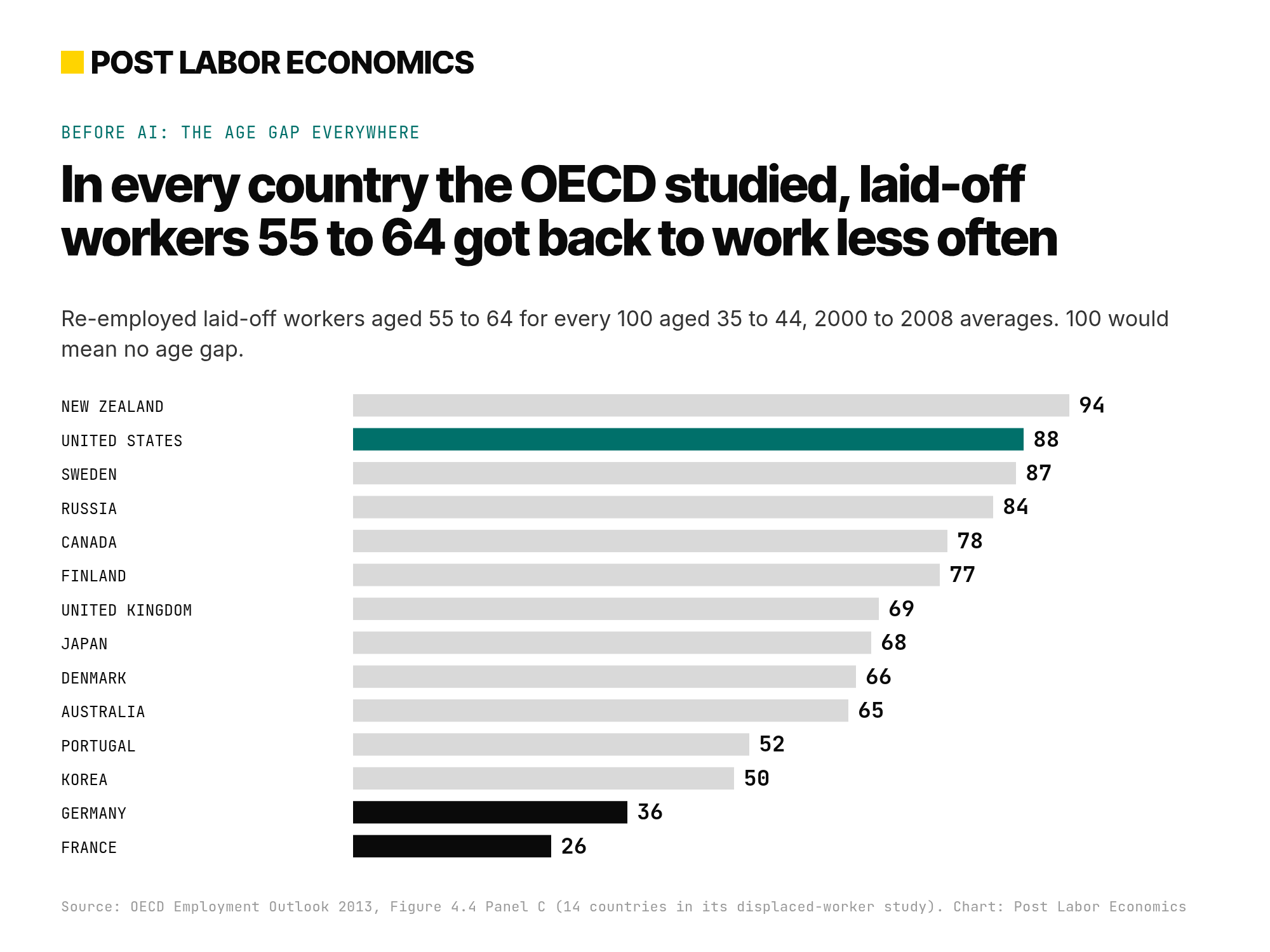
In Germany, older workers’ rate was about a third of the prime-age rate. In France, it was about a quarter.
These data are old, and they predate AI entirely. But they’re the most consistent picture available, and they make one point clearly: losing a job in your late 50s is harder almost everywhere, and AI is arriving on top of that.
I couldn’t find comparable reemployment data for China or India. Japan and Korea are in the OECD study, with about half of displaced workers back at work within a year in both, but neither has published anything like Goldman’s AI analysis that I could find.
Where Shawn K’s search led
Shawn K didn’t blame the technology itself. He called himself an “AI maximalist” in the Fortune interview, and said his frustration was with how companies use it.
“If I can do the same work that 10 developers were doing with one developer, let’s just cut the developer team,” he said, describing the mindset he objects to, instead of using the same team to do far more work.
Shawn K’s essay shows how a search like his drains a household. He wrote that New York’s unemployment system paid him under $2,000 a month for six months, which didn’t cover his basic costs, before the benefits ended.
He looked at retraining. Fortune reported he considered a tech certificate or a commercial driver’s license, and dropped both because of the cost.
In his essay, he said the trades he researched, from crane operation to drone surveying, required thousands of dollars in upfront training. He started a pressure-washing business on credit instead.
That’s the part of retraining advice that rarely gets mentioned. The jobs exist.
On my podcast in 2022, talking with John Flanagan of CareerSource Tampa Bay, I said, “We work a lot with home service companies, and they are dying for more techs. And that’s one of the best jobs. … There are some really amazing jobs out there.”
I still think that. But the path into those jobs costs money and time that a laid-off worker in month eight doesn’t have.
Shawn K did get back into engineering. By late 2025, his Substack profile described him as a “Director of Engineering using 100% AI code gen,” according to an archived copy.
His profile no longer lists a title, and I couldn’t confirm where he works today. But the shape of his return matches Goldman’s last finding almost exactly.
AI-displaced workers who get rehired are more likely to leave their old occupation, and when they do land, many, “especially older ones,” move into roles with similar or higher AI exposure, according to the Fortune report. Shawn K came back to run code that AI writes.
His comeback took more than a year and about 800 applications. If you’re over 35 and you’ve just been laid off from an AI-exposed job, budget for that version of the search from the first week. Plan your money for a year without a paycheck, and treat anything faster as a gift.
Coming up: the October jobs report (November 6) will update long-term unemployment. The Displaced Worker Supplement runs every two years, so the next full government count of displaced workers would come from a January 2028 survey.