
AI Labor Tracker
The Day Insurance Brokers Got 'AI'd,' and What the Payroll Data Says
A chatbot app knocked billions off broker stocks in a day. The jobs data tells a slower, stranger story, and it started before the app.
−90,000
Change in U.S. jobs at insurance carriers and related activities since May 2025 (BLS, Sept 2026)
On Feb. 9, 2026, U.S. insurance broker stocks had one of their worst days in years.
Willis Towers Watson fell 12%, its worst session since November 2008, Bloomberg reported.
Arthur J. Gallagher dropped 9.9% and Aon 9.3%.
The wider S&P 500 Insurance index closed down 3.9%, its biggest drop since October.
The trigger looked small. That morning, Insurify, a Cambridge, Massachusetts, online insurance agent, announced an app inside ChatGPT that lets drivers compare car insurance quotes by typing questions in plain language.
“Shopping for car insurance has traditionally been time-consuming, confusing, and frustrating for many drivers,” said Snejina Zacharia, Insurify’s founder and CEO. The app, she said, makes it “feel as simple as having a conversation.”
The same day brought news, first reported by Reinsurance News, that OpenAI had approved a home insurance app from Tuio, a Spanish digital insurer. Analysts credited one app or the other, or both, for the slide.
“The insurance broker stocks are getting hammered,” Bloomberg Intelligence analyst Matthew Palazola said.
So the market decided, in one afternoon, that a chatbot could do a broker’s job. The question for anyone who sells or services insurance is whether the jobs data agrees.
What the apps actually do
Start with what Insurify launched. The app shows tailored rate estimates based on location, vehicle, age, credit and driving record, and compares insurers side by side.
When drivers are ready to buy, they leave ChatGPT and finish on Insurify’s own site, where it’s a licensed agent in all 50 states. So the chatbot finds the customer, and an agent still writes the policy.
There’s a small wrinkle in the record. Insurify’s press release went out on Feb. 9, but Bloomberg reported the firm said the app launched on Feb. 3.
Either way, investors noticed it on the 9th.
Tuio’s app, built on WaniWani’s distribution software, gives a personalized home insurance quote inside ChatGPT, Reinsurance News reported. Both apps sell personal insurance to households, the simplest corner of the business.
Broker stocks fell 7.5% to 12.1% on Feb. 9, 2026, vs 3.9% for the insurance index
Percent change, one trading day
−12.1%
Willis Towers Watson's one-day drop on Feb. 9, 2026, its worst session since November 2008.
Bar chart. Use the up and down arrow keys to move through 5 categories. A data table follows.
Willis Towers Watson: One-day change −12.1%
- WTW: worst session since November 2008
- Brokers fell about 2 to 3 times the index
Figure 1. One-day share price change on Feb. 9, 2026, for four large insurance brokers and the S&P 500 Insurance index.
Sources: Bloomberg via The Straits Times, Feb 10, 2026; CNN Business, Feb 16, 2026; Yahoo Finance daily closes, Feb 6 and Feb 9, 2026. Chart: Post Labor Economics Download CSV Methodology
Data table
The drop followed ChatGPT insurance apps from Insurify (U.S.) and Tuio (Spain). WTW's −12.1% is computed from closes of $330.04 (Feb. 6) and $290.09 (Feb. 9); Bloomberg rounds it to 12%. Gallagher −9.9% (CNN: −9.85%), Aon −9.3% and the index −3.9% per Bloomberg; Marsh −7.5% per CNN. The index includes these brokers. Insurance distribution shares rallied about 7% over the next three weeks, Fortune reported.
| name | One-day change |
|---|---|
| Willis Towers Watson | −12.1% |
| Arthur J. Gallagher | −9.9% |
| Aon | −9.3% |
| Marsh | −7.5% |
| S&P 500 Insurance index | −3.9% |
The analysts said “overdone.” Then one bank ran the numbers
Wall Street pushed back within a day. Goldman Sachs called the roughly 9% average decline “overdone.” KBW called it a significant overreaction, especially for commercial brokers.
KBW’s reasoning was the important part. These apps are lead generators for personal lines like car and home insurance, and complex commercial accounts will “likely long warrant an actual advisor.”
UBS analyst Brian Meredith called the selloff “meaningfully overdone,” CNN reported, calling brokers “essential intermediaries” for household financial decisions.
BMO put a number on its skepticism. It expected brokers’ revenue over the next one to two years to be hit by nothing close to the 10% selloff.
The stocks seemed to agree. Over the next three weeks, insurance distribution shares rallied about 7%, Fortune reported.
Then Bank of America published the scarier version. Its analysts looked at just six carriers that sell to small businesses and households, and found more than $15 billion in 2025 commissions to independent agents that skew toward “low complexity” work.
“Our view is that large language model digital agents can effectively do a non-immaterial portion of the work currently provided by 20-30k independent agents across the United States,” the BofA report said.
BofA also argued that big brokers are more exposed than they look. Years of “tuck-in M&A,” it said, brought hundreds of small agencies and their routine policies under large brokers’ umbrellas, a “snowball effect” that thin public disclosures hide.
And it rejected the comparison to self-driving cars, which need trillions of dollars of infrastructure. Chatbots are cheap and already here, it noted, pointing to Next Insurance, owned by Munich Re, whose website chatbot lets customers buy and bind commercial policies without a human agent.
BofA was careful about scale. Total U.S. independent agency commissions and broker fees topped $100 billion in 2025, it estimated, Insurance Journal reported, so the at-risk slice it identified is a minority.
“We are not arguing that insurance intermediaries will disappear or that Coca-Cola will buy its insurance from a chatbot,” BofA wrote. Its comparison was print advertising, which Google and Facebook didn’t kill overnight but shrank over 20 years.
What the payroll data says
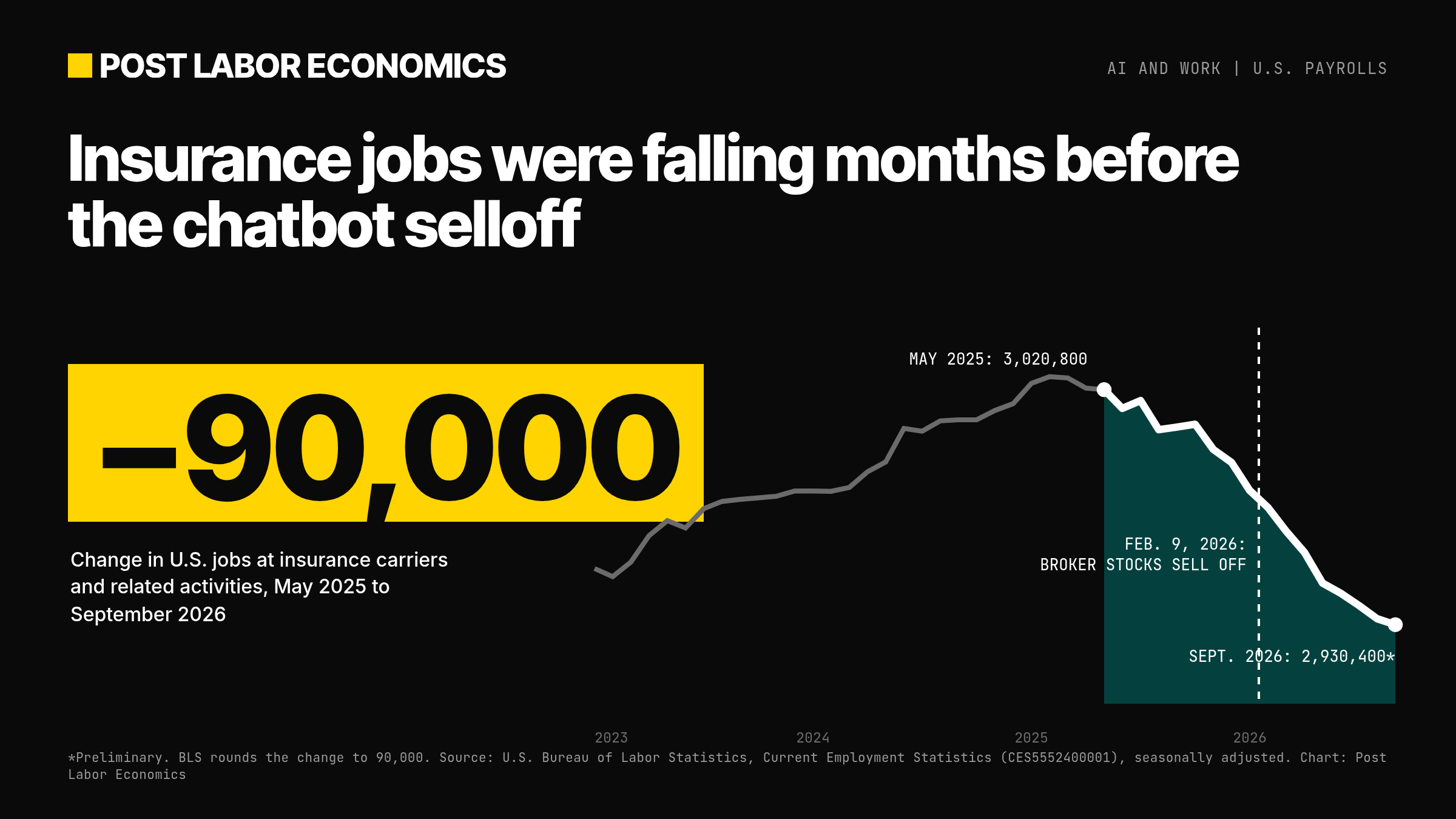
Now the jobs. In its September report, BLS said financial activities employment was down 129,000 since a peak in May 2025, “with most of the job loss in insurance carriers and related activities (-90,000).”
That category includes the insurers themselves and the agencies and brokerages that sell for them. I pulled the BLS monthly series to see which side is shrinking, and when.
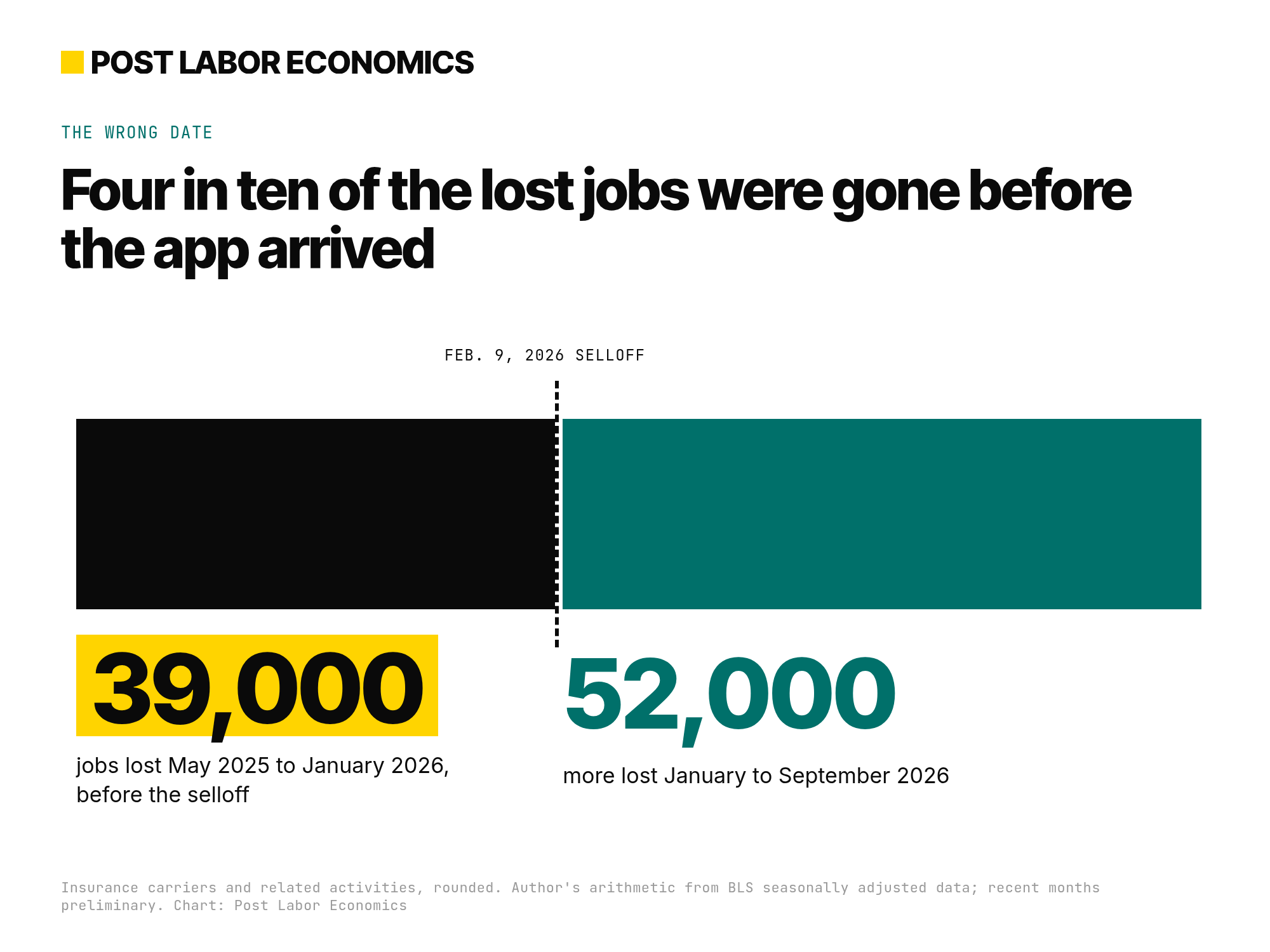
The answer is both, and it started well before the chatbot day. From May 2025 to January 2026, the month before the selloff, the industry shed about 39,000 jobs. From January to September 2026 it lost about 52,000 more (my arithmetic from BLS seasonally adjusted data; recent months are preliminary).
Insurance carriers and related activities lost 90,000 jobs from May 2025 to September 2026
Thousands of jobs, seasonally adjusted
−90,000
Change in U.S. jobs at insurance carriers and related activities, May 2025 to September 2026 (preliminary).
Line chart. Use the left and right arrow keys to move through 45 periods. A data table follows.
2026-09: Total, carriers and related activities 2,930.4
Figure 2. U.S. jobs at insurance carriers and related activities, January 2023 to September 2026.
Source: U.S. Bureau of Labor Statistics, Current Employment Statistics (CES5552400001, CES5552410001, CES5552420001), seasonally adjusted. Chart: Post Labor Economics Download CSV Methodology
Data table
BLS total (CES5552400001): 3,020,800 in May 2025 to 2,930,400 in September 2026 (preliminary), −90,400; BLS rounds to −90,000. May 2025 is the financial activities peak; the insurance total peaked at 3,025,800 in February 2025. The two parts run to August 2026; BLS adds September on Nov. 6, 2026. May 2025 to August 2026: carriers −47,800; agencies, brokerages and related −41,200. Agencies and brokerages are still +24,600 (+1.8%) from January 2023 to August 2026. The Feb. 9, 2026 selloff falls between the January and February readings. Data as published Nov 2, 2026; subject to revision.
| month | Total, carriers and related activities | Insurance carriers | Agencies, brokerages and related |
|---|---|---|---|
| 2023-01 | 2,952.0 | 1,619.8 | 1,333.5 |
| 2023-02 | 2,948.9 | 1,619.1 | 1,331.0 |
| 2023-03 | 2,954.5 | 1,618.4 | 1,336.4 |
| 2023-04 | 2,964.7 | 1,619.2 | 1,345.2 |
| 2023-05 | 2,970.4 | 1,619.6 | 1,350.2 |
| 2023-06 | 2,967.6 | 1,619.5 | 1,347.0 |
| 2023-07 | 2,975.0 | 1,621.9 | 1,352.9 |
| 2023-08 | 2,977.8 | 1,623.2 | 1,354.6 |
| 2023-09 | 2,978.6 | 1,620.8 | 1,358.0 |
| 2023-10 | 2,979.2 | 1,617.0 | 1,362.8 |
| 2023-11 | 2,979.8 | 1,612.8 | 1,367.7 |
| 2023-12 | 2,981.8 | 1,611.1 | 1,371.5 |
| 2024-01 | 2,981.8 | 1,612.3 | 1,370.7 |
| 2024-02 | 2,981.7 | 1,610.2 | 1,373.0 |
| 2024-03 | 2,983.2 | 1,607.8 | 1,375.5 |
| 2024-04 | 2,989.2 | 1,614.9 | 1,374.1 |
| 2024-05 | 2,993.0 | 1,617.1 | 1,377.1 |
| 2024-06 | 3,005.9 | 1,622.9 | 1,383.5 |
| 2024-07 | 3,004.8 | 1,620.6 | 1,384.0 |
| 2024-08 | 3,008.8 | 1,620.5 | 1,388.7 |
| 2024-09 | 3,009.2 | 1,621.8 | 1,388.0 |
| 2024-10 | 3,009.2 | 1,620.4 | 1,389.4 |
| 2024-11 | 3,012.8 | 1,622.4 | 1,390.9 |
| 2024-12 | 3,015.4 | 1,623.2 | 1,393.1 |
| 2025-01 | 3,023.2 | 1,626.0 | 1,400.4 |
| 2025-02 | 3,025.8 | 1,626.4 | 1,398.3 |
| 2025-03 | 3,025.3 | 1,625.7 | 1,399.6 |
| 2025-04 | 3,021.4 | 1,623.8 | 1,397.6 |
| 2025-05 | 3,020.8 | 1,622.6 | 1,399.3 |
| 2025-06 | 3,013.6 | 1,618.2 | 1,395.9 |
| 2025-07 | 3,016.6 | 1,618.0 | 1,398.3 |
| 2025-08 | 3,005.4 | 1,613.2 | 1,392.6 |
| 2025-09 | 3,006.4 | 1,611.6 | 1,395.5 |
| 2025-10 | 3,007.5 | 1,612.5 | 1,396.1 |
| 2025-11 | 2,997.8 | 1,608.8 | 1,389.7 |
| 2025-12 | 2,992.8 | 1,607.6 | 1,386.2 |
| 2026-01 | 2,982.0 | 1,601.6 | 1,382.8 |
| 2026-02 | 2,975.5 | 1,596.5 | 1,377.8 |
| 2026-03 | 2,966.4 | 1,591.9 | 1,374.4 |
| 2026-04 | 2,958.3 | 1,583.0 | 1,370.4 |
| 2026-05 | 2,946.4 | 1,579.7 | 1,366.2 |
| 2026-06 | 2,942.5 | 1,576.9 | 1,365.4 |
| 2026-07 | 2,937.8 | 1,575.8 | 1,360.2 |
| 2026-08 | 2,932.7 | 1,574.8 | 1,358.1 |
| 2026-09 | 2,930.4 | not yet published | not yet published |
Split by type, carriers lost about 48,000 jobs from May 2025 to August 2026, and agencies and brokerages about 41,000. The broker side, the one the market was worried about, is shrinking at a similar pace to the insurers. Measured from January 2023, broker payrolls are still up about 25,000, or 1.8%, because they climbed to a peak of about 1.4 million in January 2025 before the slide began.
How typical is this? Insurance employment still sits above its February 2020 level of about 2.86 million. It had grown to a peak in early 2025 before turning down.
My read: the market panicked about the wrong date. If AI is shrinking insurance payrolls, it’s doing it through the back office, through claims processing, policy checks and service work, and it started before any chatbot sold a car policy.
The honest limit is that BLS doesn’t say why these jobs are going. Softer insurance markets, acquisitions and ordinary cost-cutting could explain much of it, and nothing in the data ties a single job to AI.
What the people in the job say
Insurance Journal asked account managers and customer service reps how AI is changing their work this summer. Their answers were more specific than any analyst note.
Kimberly Garza, a senior commercial lines CSR at Higginbotham with almost 38 years in the business, told Insurance Journal her first reaction to AI was “I’m too old for this.” Now, she said, “I love it.”
What she loves is AI policy checking. “It checks the policy against the proposal that was submitted to the client, and it also checks against the proposal, the policy, and our agency management system, all three,” she said. That used to be done by hand.
Michelle Salow, an executive account manager at Heffernan who started in 2003, said AI now does “the initial phases of a lot of the tasks,” from proposals to premium and loss comparisons. “Then account managers are just having to verify the information that doesn’t match,” she said.
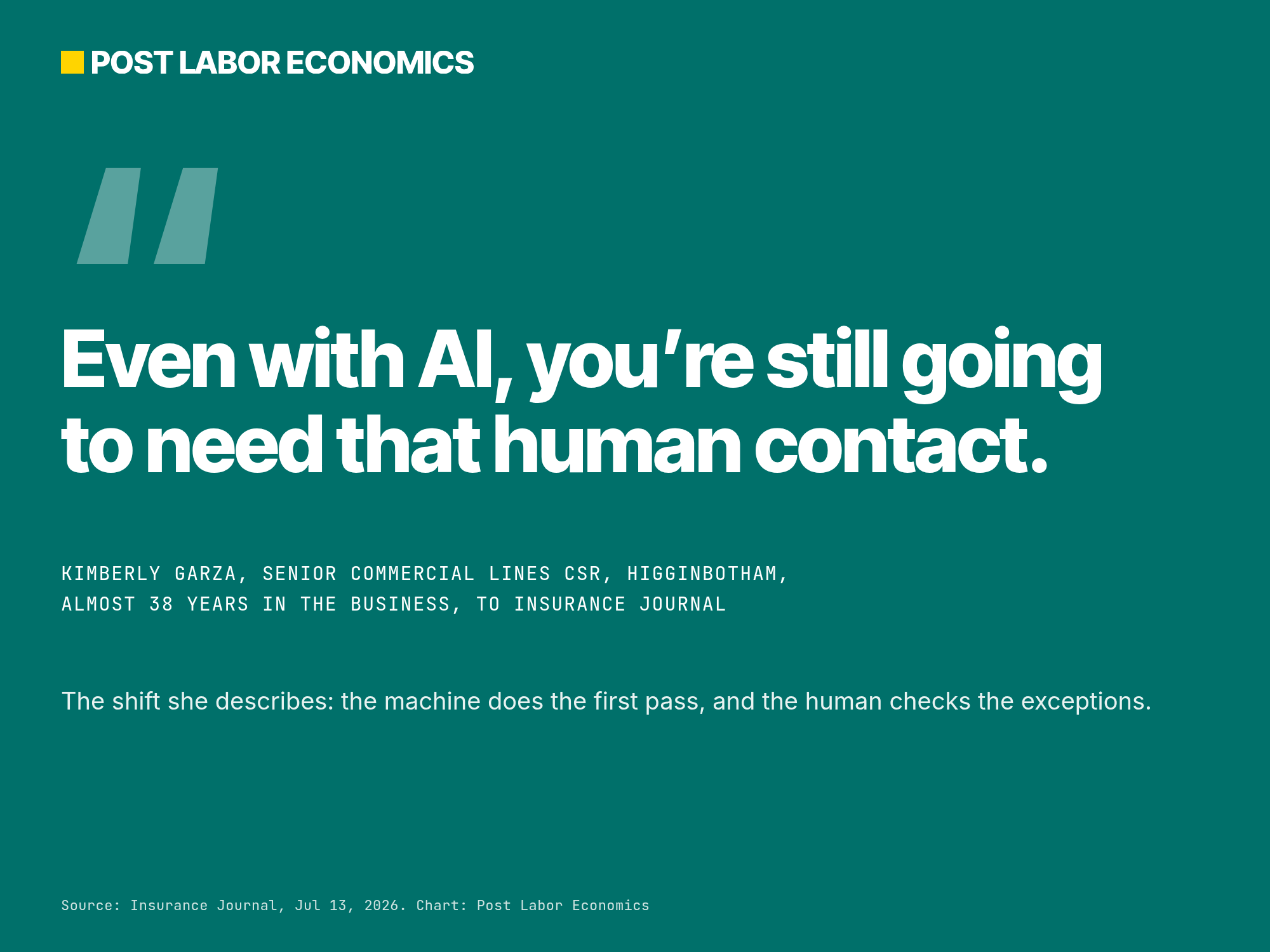
Neither expects to be replaced, and both describe the same shift: the machine does the first pass, and the human checks the exceptions. “Even with AI, you’re still going to need that human contact,” Garza said.
The recruiters are more blunt about who’s exposed. Mary Newgard of Capstone Search Group said service positions that are only administrative, with little client contact, could be cut. “If AI can assume those service functions, then agencies stand to save a lot of time and money paying people to do those tasks,” she said.
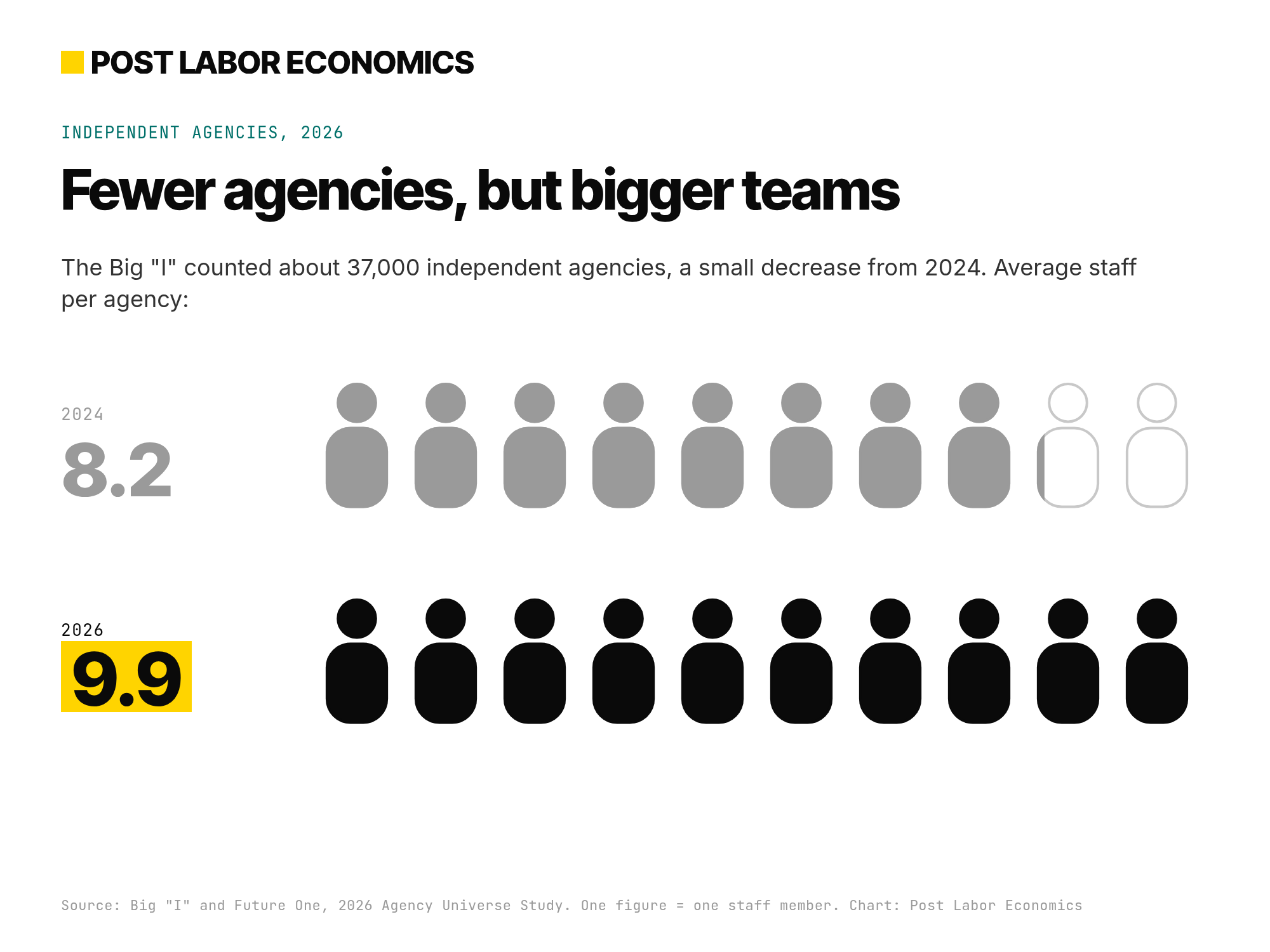
The agency owners’ trade group sounds calm. Its 2026 Agency Universe Study counted about 37,000 independent agencies, a small decrease from 2024, the Big “I” said.
Average agency staff rose to 9.9 people from 8.2 two years earlier, the same study found.
Nearly half of agencies now use AI, up from 15% in 2024. Charles Symington, the Big “I” CEO, called the channel “stable, resilient and well-positioned for the future,” which is what trade associations call their members in every kind of weather.
Who loses and who gains
The BLS outlook for insurance sales agents is flat, not collapsing. It projects 3% growth from 2025 to 2035 for the 572,600 people in the job, in its latest handbook.
The median agent earned $62,280 in May 2025.
BLS already builds in the online shopper. “Many clients do their own research and purchase insurance online, which reduces demand for an insurance sales agent’s services,” it says, though agents “will still be needed to help clients understand their options.”
So who loses? The people doing the work BofA called low complexity: quoting standard car and home policies, and the back-office service reps whose work Newgard thinks could be cut. Those are also the jobs people tend to start in.
Who gains? Buyers, first. BofA expects AI to “de-mystify insurance markets” and push prices down even for big corporate buyers.
Agents who handle complex accounts gain too. So do the digital agents themselves, like Insurify, which is itself a licensed agency that closes the sale.
The international picture is thin but points the same way. One of the two apps came from Spain, which suggests personal-lines insurance is being sold by chatbot on both sides of the Atlantic. I haven’t found comparable European payroll data for insurance distribution, so I won’t claim a trend there.
Where it stands
As of the latest BLS report, insurance carriers and related activities have about 90,000 fewer jobs than in May 2025. Broker stocks recovered much of the February drop within weeks, and the BLS October jobs report is due Nov. 6.
The scare trade didn’t stay in insurance, either. The same week, CNN reported, AI-disruption fears hit wealth managers, real estate services firms and trucking brokers, as investors scrutinized “high-fee, labor-intensive business models,” as KBW analyst Jade Rahmani put it about real estate services. Brokers were just the first in line.
If you work in insurance, here’s my one piece of advice: move toward the work AI checks rather than the work AI does. Learn the policy-checking and comparison tools now, and build the client relationships that Garza, Salow and the analysts all named as the part a chatbot can’t take. That’s my recommendation.