
AI Labor Tracker
$6.6M Per Employee at Anthropic. Juniors Fell From 27% to 9% of Tech Hires
Anthropic's IPO filing checks out on most of what the All-In hosts said about revenue and customers. The workforce numbers inside it, and the company's own study of its staff, say more about the jobs AI is changing first.
$6.6M
Anthropic's trailing-12-month revenue per employee as of Sep 30, 2026, up from $1.4M a year earlier (Anthropic S-1/A, Nov 2, 2026)
If you’ve used Claude late at night, you may have seen the greeting “Hello night owl.” Someone wrote that. It came from a small product design team at Anthropic whose job included writing the short lines that greet people on Claude.ai, like “Coffee and Claude time?”
In spring 2026, that team built what Anthropic calls a context graph, a structured set of guidance that got Claude agents writing that kind of product copy well. It “scaled the team out,” the team’s manager said, according to a report by Anthropic’s own economists published October 16.
It also, the report says, “raised the question of what was left for human writers.”
The report doesn’t say anyone on the team lost a job. They rotated into new work: writing the prompts and tests that shape how Claude behaves. “Writers who used language to drive human behavior are now using it to drive Claude behavior,” the report quotes.
That team isn’t an outlier inside Anthropic. Employees who had been there at least a year were 50% more likely to move to a different department each month in 2026 than in 2025, the same report found, as whole teams handed work to agents.
On October 26, Anthropic filed to go public. Its S-1, amended today with third-quarter numbers, is the most detailed look yet at what a company built around AI looks like from the inside.
Checking the hosts’ numbers
The October 30 episode of All-In opened with the filing. Jason Calacanis read out the headline figures, and David Sacks, asked whether this was “the greatest business in the history of capitalism,” made the bull case.
Here’s how their claims check against the filing.
First-half revenue: right. Calacanis said $16.3 billion for the first six months of 2026. The S-1 reports $16.29 billion.
He also said that was about 14 times the first half of 2025. The filing’s numbers bear that out.
Second-quarter revenue: right. He said Q2 would be “a whopping 11.6 billion.” The filing shows $11.56 billion.
Today’s amendment adds the third quarter, at $16.96 billion. That’s more than Anthropic made in all of 2025.
Big customers: right. One of the hosts tracked customers spending $100,000 or more a year, from 200 at the end of 2024 to 1,500 a year later. The S-1 gives those same rounded counts.
It shows more than 11,900 such customers as of September 30, 2026, also as the host said.
The filing also counts about 250 customers paying $10 million or more a year.
Seven founders with 50.1% of the vote: right. The filing says the single Class F share “will be entitled to an aggregate number of votes that equals 50.1% of the total voting power.”
About $112 billion in cash: right, for June 30. The original S-1 listed $112.4 billion in cash as of June 30.
Today’s amendment updates that. As of September 30, Anthropic had $95.6 billion in cash plus $36.3 billion in short-term investments.
The $80 billion “phantom” loss: mostly right. Sacks called it “basically a fake number” created by convertible notes. The filing shows a first-half net loss of about $80.7 billion.
Most of that was a $72.4 billion noncash charge for the rising value of those instruments. Another $8.8 billion came when they were first recorded.
Without those charges, Anthropic lost about $0.7 billion from operations in the first half. It turned an operating profit of nearly $1 billion in the second quarter.
The loss isn’t gone, though. Anthropic still reported a third-quarter net loss of about $23.3 billion, mostly from the same kind of charge.
“Around $110 billion” raised: wrong. The filing says Anthropic had raised $141.1 billion in total as of September 30.
Sacks’s broader point, that the company spent far less than it raised, holds up. Operating cash flow was positive, about $6.6 billion, over the first nine months of 2026, by the filing’s cash flow statement.
Gross margin “something like 85%”: right, by my calculation. Revenue minus cost of revenue in the S-1 works out to about 85% for the first half of 2026.
That line leaves out the cost of training new models. Training is a large share of what Anthropic spends on compute, so the margin flatters the business a bit.
Who owns the upside
Sacks also said there was a tweet that morning about how the wealth would spread. “Hundreds and hundreds of employees are going to be making hundreds of millions of dollars,” he said, “and then thousands of employees are going to be making $10 million plus.”
Thousands of employees at $10 million or more: unverifiable. The S-1 doesn’t break down holdings by employee. It does show how big the employee pool is.
As of September 30, there were outstanding options on about 1.77 billion shares under the company’s stock plan. They carry an average exercise price of $2.91.
The plan also had about 1.13 billion restricted stock units outstanding.
Anthropic’s last private round, in May and June 2026, sold preferred shares at $589.01 each. A 10-for-1 split followed in September.
At the split-adjusted price of about $58.90, those options and units would be worth roughly $165 billion, by my arithmetic.
That’s not a market price, and the IPO price hasn’t been set. The pool also includes former employees. Spread across a staff of about 5,300, though, the claim looks plausible.
The seven co-founders together own about 1.7 billion shares, according to the beneficial ownership table. At that same price, that’s about $100 billion, also my arithmetic.
One of the hosts said “80% of the seven founder shares are going into this nonprofit entity of some type.” That’s partly right. The filing says the co-founders “have each pledged to dedicate 80% of their personal equity in Anthropic to philanthropic causes.”
It also says those pledges are “voluntary, revocable expressions” of intent and “do not constitute legally binding obligations.” No nonprofit entity is named to receive them.
A company that grows without hiring like one
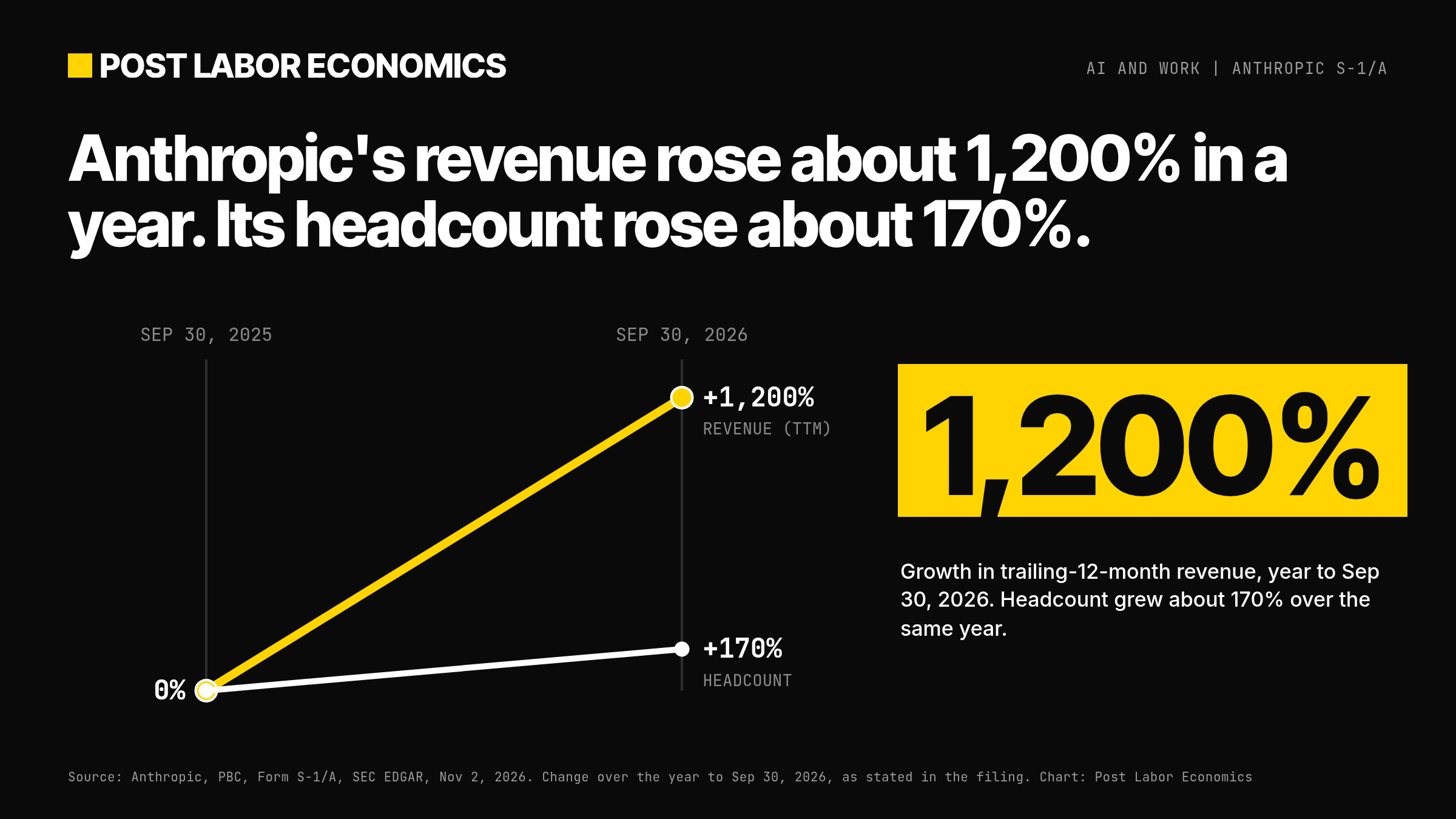
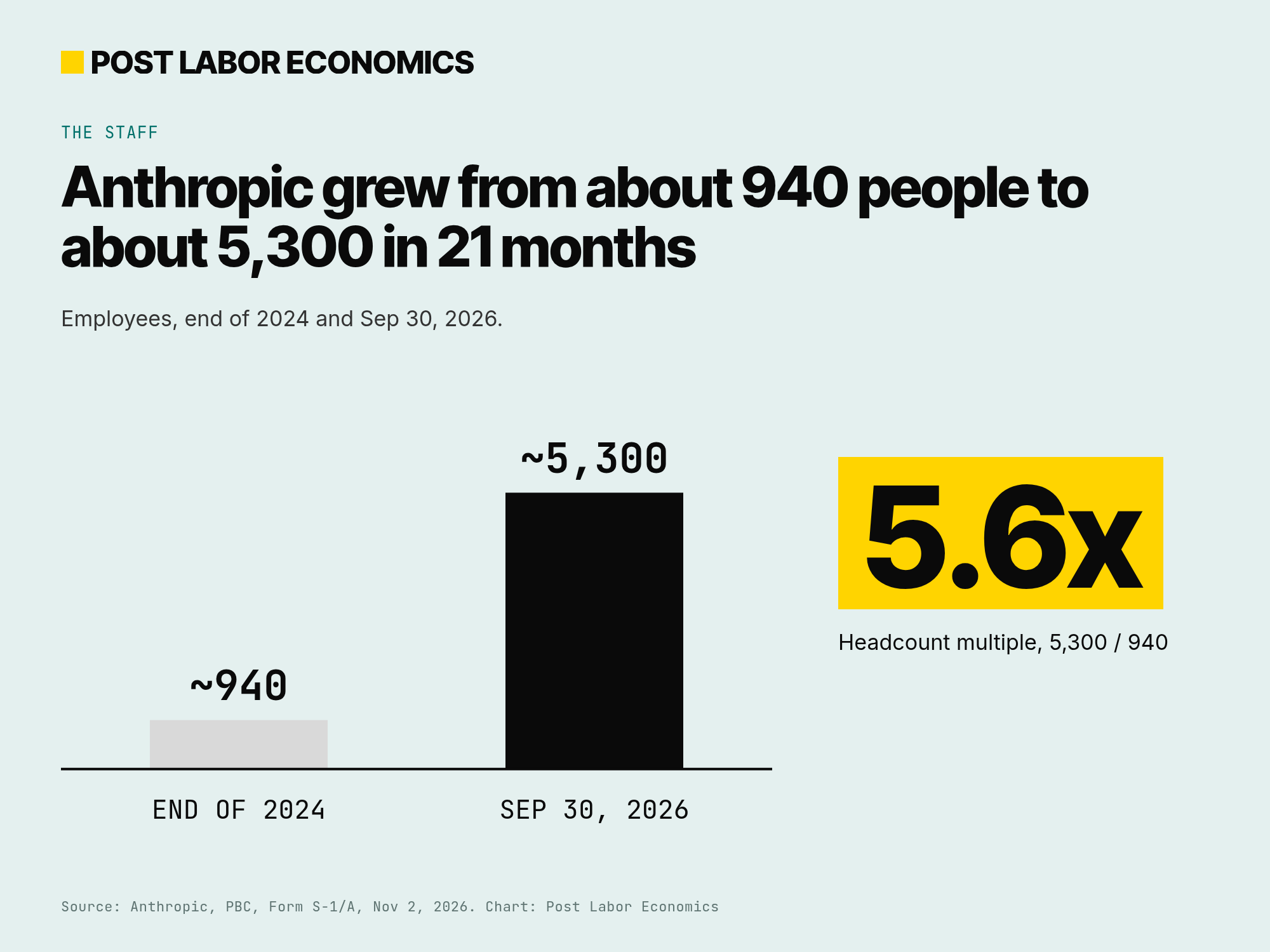
The workforce numbers are the part of the filing I’d want any worker to read. Anthropic went from about 940 employees at the end of 2024 to about 5,300 by September 30, 2026.
Over the year to September 30, 2026, trailing revenue rose about 1,200% while headcount rose about 170%, the S-1 says.
That pushed revenue per employee from $1.4 million to over $6.6 million.
Anthropic's revenue per employee rose almost fivefold, from $1.4M in Sep 2025 to $6.6M in Sep 2026
USD millions of trailing-12-month revenue per employee
$6.6M
Trailing-12-month revenue divided by employees, as stated in Anthropic's IPO filing.
Bar chart. Use the up and down arrow keys to move through 2 categories. A data table follows.
Sep 30, 2025: Revenue per employee $1.4M
Figure 1. Anthropic's trailing-12-month revenue per employee, Sep 30, 2025 vs Sep 30, 2026, as reported in its S-1/A.
Source: Anthropic, PBC, Form S-1/A, SEC EDGAR, Nov 2, 2026. Chart: Post Labor Economics Download CSV Methodology
Data table
The filing gives the Sep 30, 2026 value as 'over $6.6 million.' Company-reported operating metric, not audited. Headcount was about 5,300 on Sep 30, 2026.
| label | Revenue per employee |
|---|---|
| Sep 30, 2025 | $1.4M |
| Sep 30, 2026 | $6.6M |
The filing calls this “a reflection of extraordinary talent density and a culture built to compound it.” Every S-1 has a sentence like that. This one at least comes with a number attached.
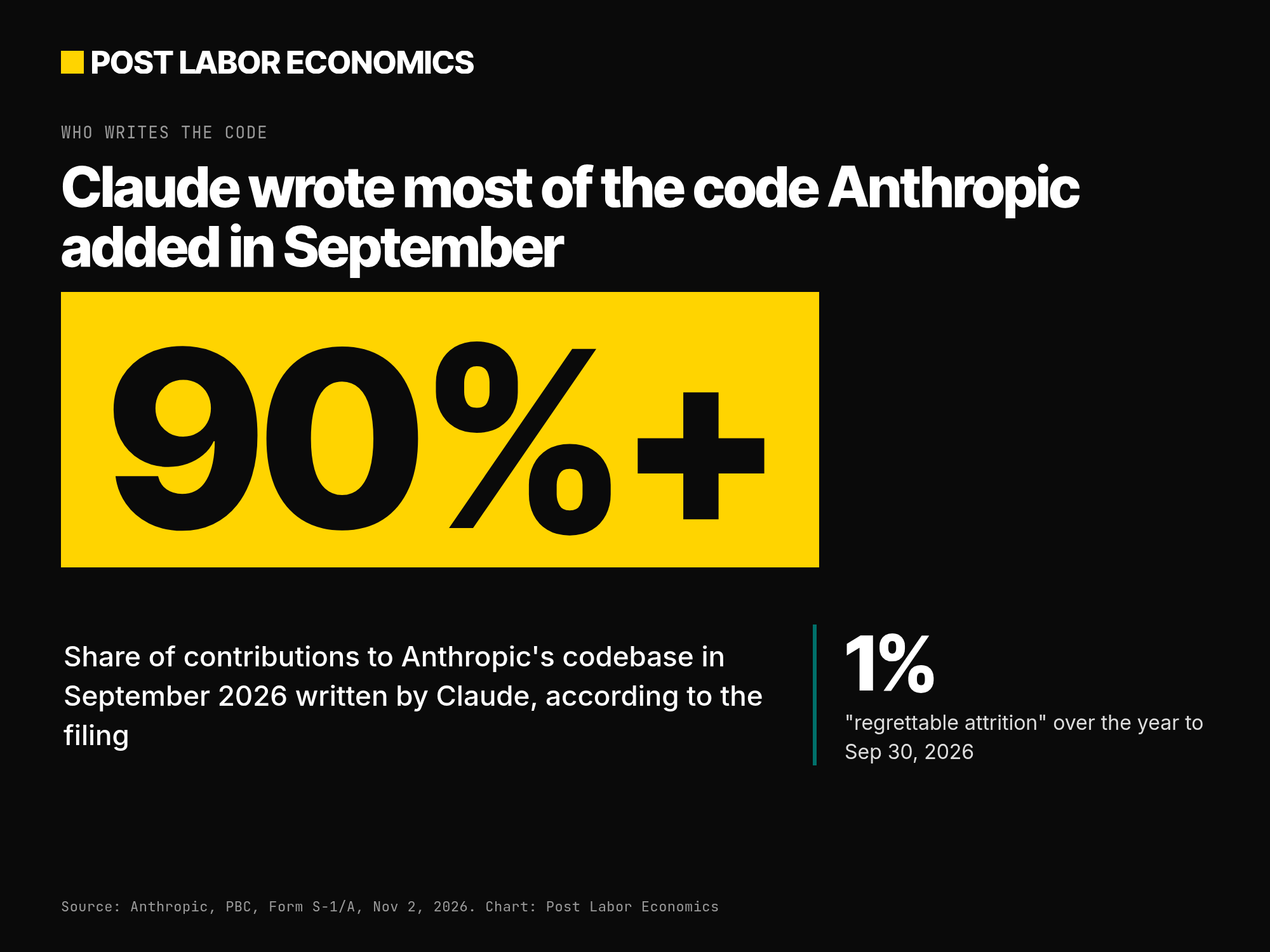
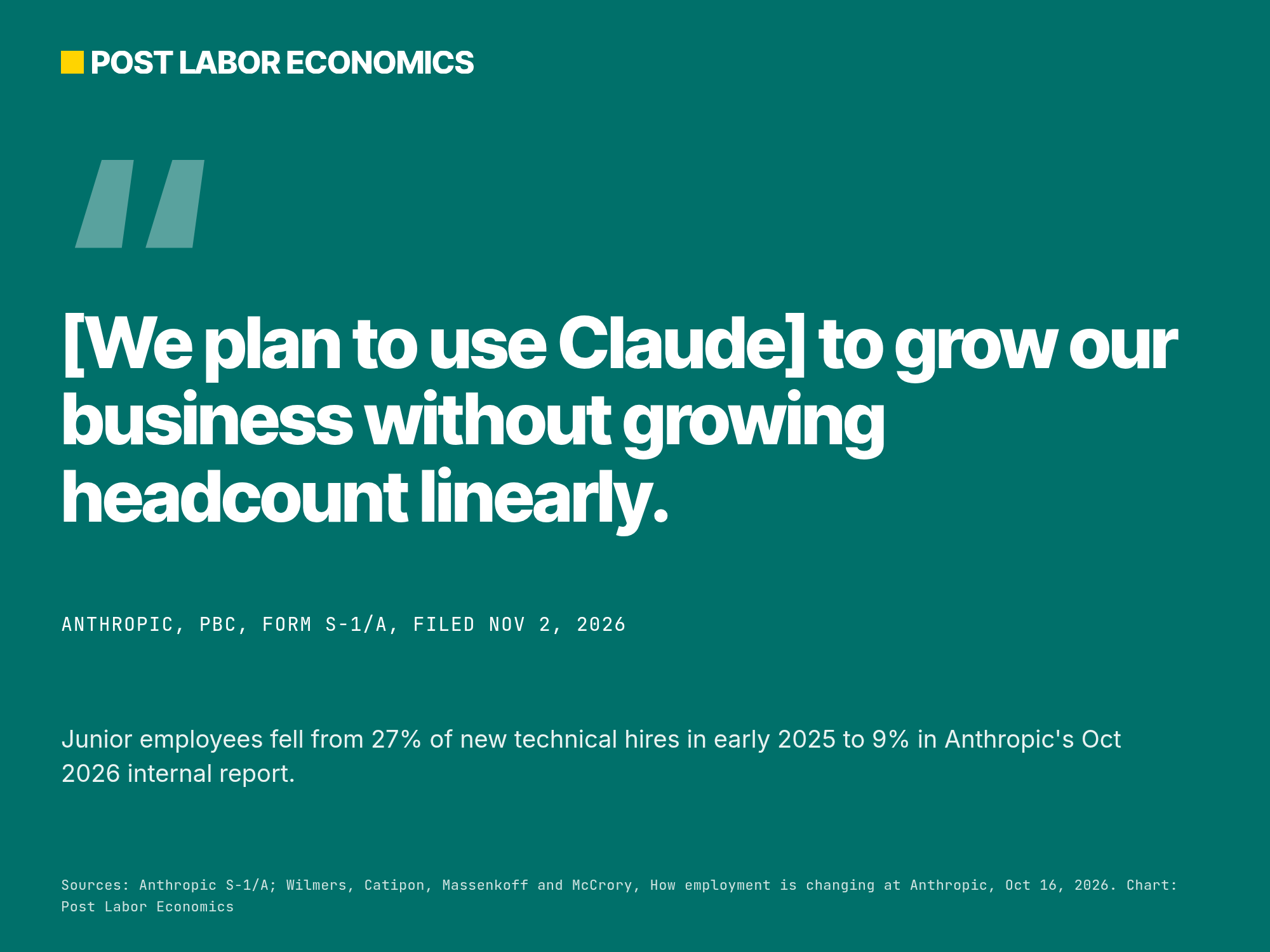
The rest of the explanation is Claude. “Over 90% of the contributions to our codebase in September 2026 were written by Claude,” the filing says. It also says Anthropic plans to use Claude “to grow our business without growing headcount linearly.”
The company’s economists measured what that looks like from the inside. Interactive AI agents logged six times as many hours as their human handlers by August, and code commits per engineer were five times what they had been six months earlier.
Aaron Cleavinger, an executive recruiter at Flatiron Search Partners, told Business Insider that “head count is becoming a less meaningful measure of organizational capability.” For a lot of companies that will read as a plan.
Another recruiter, Martha Heller, told the outlet it was no surprise Anthropic leans on its own product. “Of course they’re going to eat their own dog food,” she said, adding that the company still needs people to oversee what the AI does.
The people Anthropic does hire mostly stay. The filing reports about 1% “regrettable attrition” over the year to September 30, 2026, meaning departures the company didn’t want.
Where the junior jobs went
The internal report is unusually blunt about who isn’t getting hired. The share of junior employees in Anthropic’s technical departments fell from 21% to 14% since early 2025.
Among new technical hires, the junior share fell faster, from 27% to 9%. Postings for junior roles have dropped “particularly sharply since December 2025,” the economists wrote.
Juniors fell from 27% of Anthropic's technical hires in early 2025 to 9% in its Oct 2026 report
Percent of technical staff and of technical hires
9%
Junior share of Anthropic's technical hires in its Oct 2026 report, down from 27% in early 2025.
Bar chart. Use the up and down arrow keys to move through 2 categories. A data table follows.
Junior share of technical employees: Early 2025 21%, Oct 2026 14%
Figure 2. Junior share of Anthropic's technical employees and technical hires, early 2025 vs latest data in its Oct 16, 2026 report.
Source: Wilmers, Catipon, Massenkoff and McCrory, How employment is changing at Anthropic, Anthropic, Oct 16, 2026. Chart: Post Labor Economics Download CSV Methodology
Data table
Company-reported internal data from Anthropic's own economists. The report gives the start as early 2025 and does not date the endpoint precisely; it is the latest point in the Oct 16, 2026 report.
| measure | Early 2025 | Oct 2026 |
|---|---|---|
| Junior share of technical employees | 21% | 14% |
| Junior share of technical hires | 27% | 9% |
In an April 2026 survey, about a third of machine learning managers and a fifth of software engineering managers said they were hiring less because of AI. Hiring managers now put more weight on “autonomy and judgment” than on specific technical skills.
Office support work didn’t grow with the company either. An executive assistant who built a scheduling and email agent put it this way: “I think we’ve already moved past the point of Claude augmenting away the really entry-level admin type role.”
The people who stayed describe a different job. In the April survey, 20% of employees described their role shifting “from actually doing work to managing Claudes.”
One engineer described “an army of Claudes, with every one asking for my attention.” Another compared it to babysitting, where every agent’s request arrives with “the same level of concern,” whether it’s a juice box or a cut finger.
Inside Anthropic, the report says, the response has been to move people rather than cut them, backed by an early warning system that flags jobs at risk. The authors are also honest about the limit of that approach: “Employment protections for incumbents will not benefit those not hired to begin with.”
Let’s talk about the scary parts
The S-1 also has a risk factors section, and Anthropic’s lawyers wrote about jobs more directly than most companies do.
The filing warns that “public perception that our models, platform, and applications contribute to job displacement or economic disruption could generate significant negative media coverage, customer or employee backlash, or organized opposition, regardless of the actual impact.”
It goes further. “To the extent the rate of job displacement rapidly increases due to the adoption of AI,” it says, governments “may intervene to slow the rate of adoption of AI, restrict its use, or take other actions.”
And it says Anthropic “may from time to time voluntarily elect to take actions intended to ameliorate the impact of such displacement.” Any such actions, it adds, “would represent additional costs and expenditures for which we may not receive a corresponding commercial benefit.”
That’s an honest thing to put in a legal document. It also tells you how the company sizes its market.
Calacanis said on the show he didn’t know how the company “backed into” a $40 trillion market. The filing explains it: “the work that knowledge workers perform represented more than $40 trillion in economic value globally in 2025.” The footnote builds that from wage and labor-share data.
In other words, the market Anthropic is pitching to investors is the global paycheck of office workers. The filing says customers get value in “three primary ways: more productive employees, faster processes, and embedded intelligence in their products.”
My read: the first of those can mean better jobs, and the evidence inside Anthropic suggests it does for the people already there. The hiring numbers suggest the cost lands on the people who would have come next.
Back to the writers
The product design team that wrote “Hello night owl” still has work. It’s just different work, and they got to make the move inside a company that’s growing fast, paying in stock and promising to redeploy people.
Most workers whose tasks get handed to agents won’t be at a company like that. Among publicly traded Fortune 500 companies that spend $100,000 or more a year with Anthropic, its revenue averaged less than 0.1% of their total expenses in the third quarter of 2026, the S-1/A says. Most of this change hasn’t reached their workers yet.
If you write, analyze, code or handle admin work for a living, do what that team did before someone asks: learn to write the instructions and checks the agents run on. That’s the part of their old job that came with them.