
AI Labor Tracker
Nvidia's $1 Becomes $18? AI Saved 2.1% of US Work Hours
A podcast chart claimed every dollar spent on Nvidia chips becomes $18 for Anthropic, then guessed at what customers get back. Measured so far, workers have gotten a little time back and almost nothing in pay.
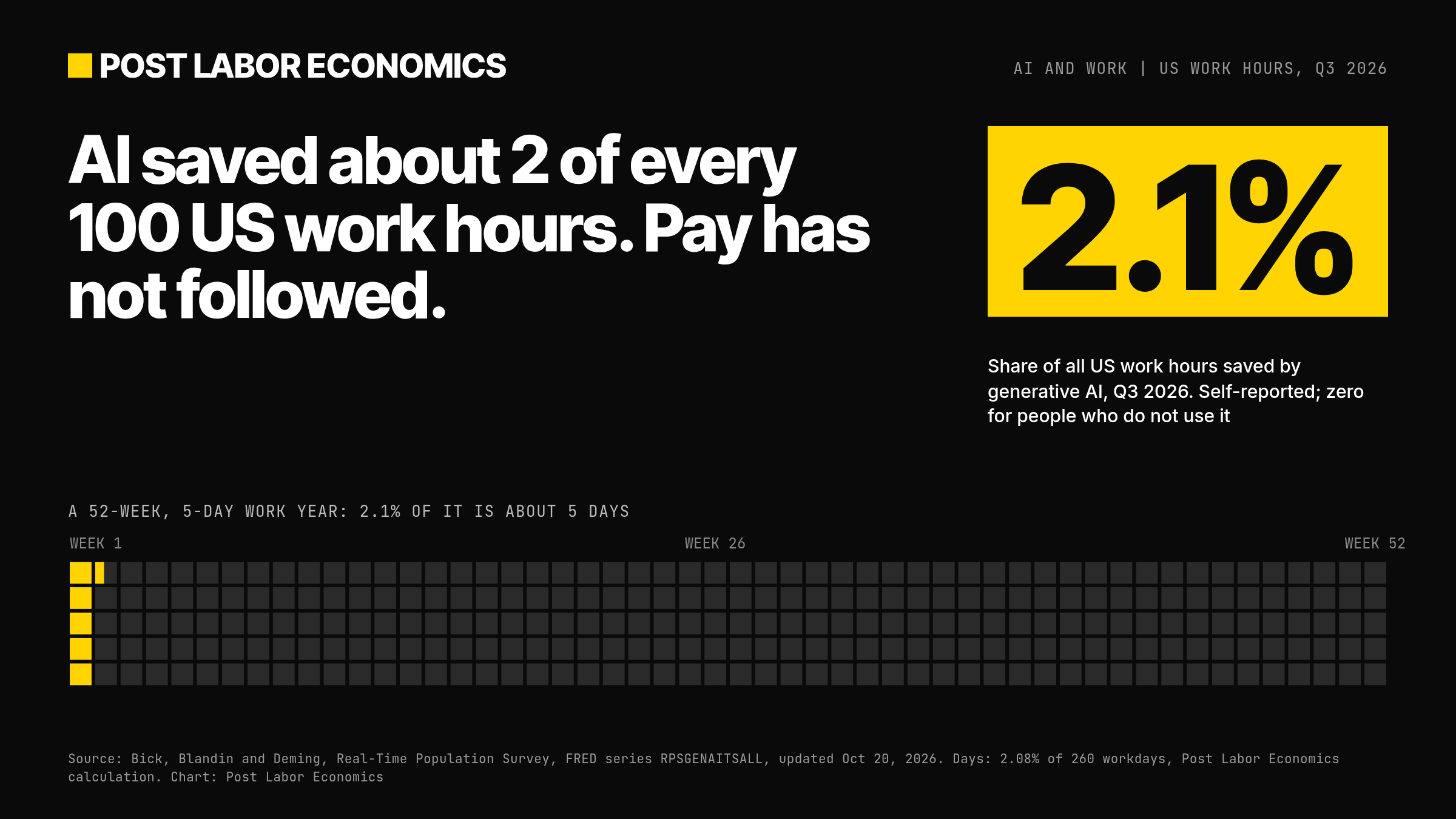
2.1%
Share of all US work hours saved by generative AI, Q3 2026 (Real-Time Population Survey via FRED, updated Oct 20, 2026)
In January, Teradata’s chief executive, Steve McMillan, sent his staff a memo about this year’s raises. There wouldn’t be any. “We will fund this AI investment by reallocating the budget from 2026 annual salary adjustments,” he wrote, according to Business Insider, which reviewed the memo.
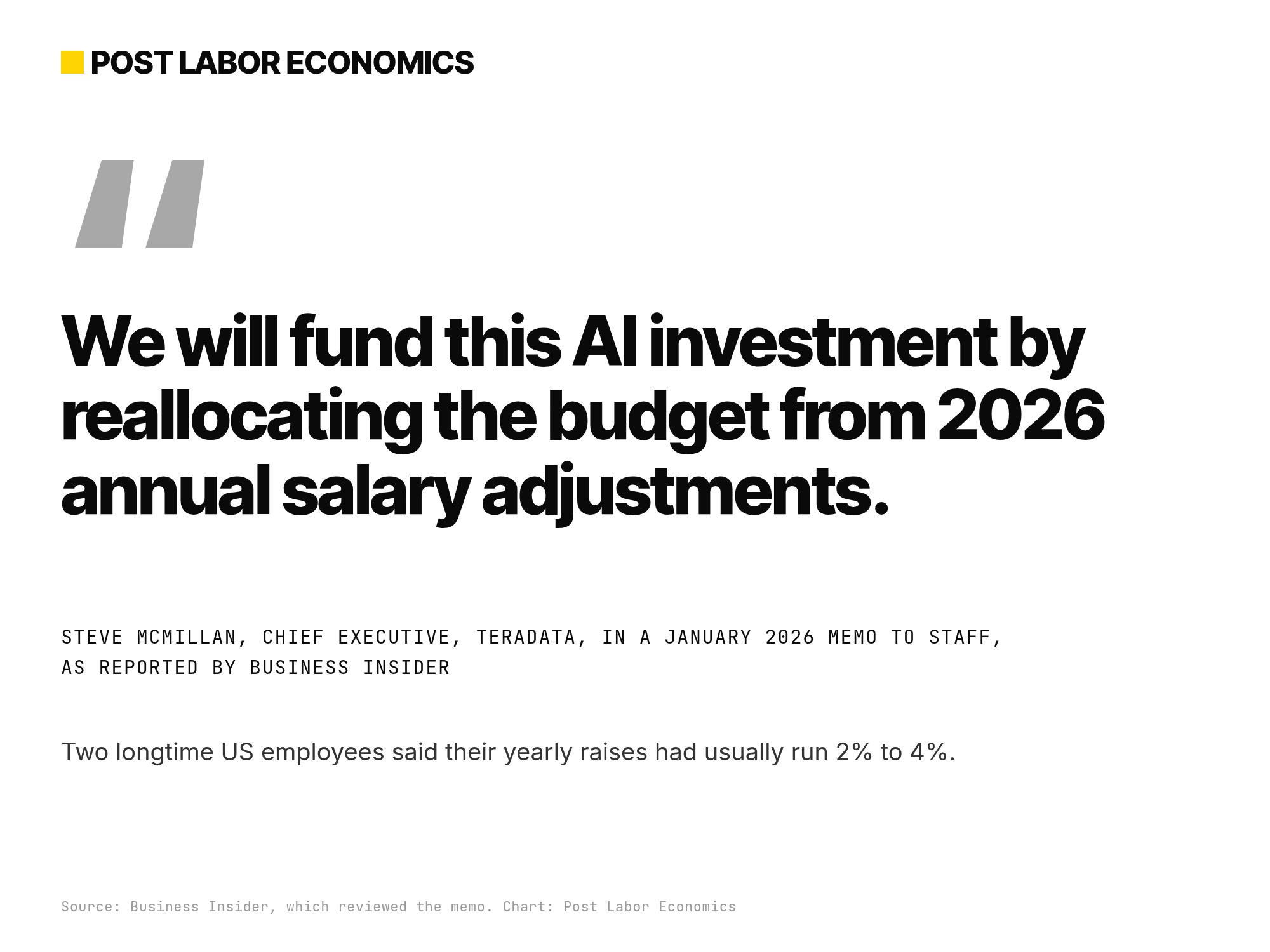
The memo told the company’s workforce it needed to “win in the market with AI.” Two US employees who had been at the data software company for more than a decade told the outlet their yearly raises had usually run 2% to 4%.
Teradata’s headcount had already shrunk by about a fifth between the end of 2023 and the end of 2025, according to its annual reports. Revenue fell about 5% in 2025.
Performance bonuses and equity were still on the table, the memo said. The pause applied in countries where regulators don’t require market-aligned pay adjustments.
Teradata isn’t alone. TTEC paused 401(k) matches for its US staff through the end of 2026 to pay for AI, and in a Resume Builder survey of business leaders, more than half said they planned to cut compensation to fund AI, Fortune reported. That’s a survey of plans, not of what companies did.
So here’s a company paying for AI out of its workers’ raises before anyone knows what AI pays back. Last week, a podcast chart tried to answer exactly that question.
The chart that turned $1 into $18
On the October 30 episode of All-In, David Friedberg walked through a chart he said his analyst made. His claim was that money spent on Nvidia chips multiplies as it moves down the chain.
“For every dollar of COGS,” he said, meaning cost of goods sold, Nvidia gets “$4 of revenue.” Then the chips land in data centers, then in Anthropic’s models, which he said run “about 85% incremental gross margin.”
“A dollar that Nvidia spends turns into $18 that Anthropic is making,” he said. The last box went a step further, saying Anthropic’s customers are making “on the order of two to 10 times the money they’re spending.”
When one of his co-hosts asked about that box, Friedberg was candid. He called it a “box I made up” and said, “I said assume 2 to 10×.”
Then he added: “I have no idea. But I’m a user of Claude.”
Here’s how each link holds up against filings.
Nvidia: right. Nvidia reported a 75.0% gross margin in its second quarter of fiscal 2027, per its CFO commentary. That works out to $4 of revenue for every dollar of cost.
Anthropic’s margin: right, with a catch. From the cost-of-revenue line in Anthropic’s S-1/A, I calculate a gross margin of about 85% for the first half of 2026.
The cost of training new models isn’t in that line, though. By my calculation, total compute spending equaled about 55% of revenue over those six months.
The $18 itself: unverifiable. The steps between Nvidia and Anthropic weren’t shown on air, and stacking the margins he read out doesn’t land on $18. I couldn’t rebuild it, so I can’t call it right or wrong.
The customer payoff: an assumption. Friedberg said so himself, and that’s to his credit. It’s also the only box in the chain that’s about the people doing the work.
What the measured payoff looks like
Economists have been measuring the worker end of that chain for two years, and the number is small. Generative AI saved about 2.1% of all US work hours in the third quarter of 2026, up from 1.4% at the end of 2024, according to the Real-Time Population Survey published on FRED.
That figure averages in everyone, including the majority who don’t use AI at work. In the same survey, 40.5% of employed adults said they used generative AI for their job in the third quarter of 2026, per FRED.
AI saved 2.1% of US work hours in Q3 2026, up from 1.4% in Q4 2024
Percent of all US work hours
2.1%
Share of all work hours that employed US adults say generative AI saved them, counting non-users as zero.
Line chart. Use the left and right arrow keys to move through 8 periods. A data table follows.
Q3 2026: Hours saved 2.1%
Figure 1. Generative AI time savings as a share of all US work hours, Q4 2024 to Q3 2026. Self-reported survey.
Source: Bick, Blandin and Deming, Real-Time Population Survey, FRED series RPSGENAITSALL, updated Oct 20, 2026. Chart: Post Labor Economics Download CSV Methodology
Data table
Real-Time Population Survey, employed adults 18 to 64. Users report how many extra hours they would have needed without AI, in brackets; time savings are zero for non-users. Not seasonally adjusted. Values rounded to two decimals in the CSV.
| quarter | Hours saved |
|---|---|
| Q4 2024 | 1.4% |
| Q1 2025 | 1.6% |
| Q2 2025 | 1.8% |
| Q3 2025 | 1.8% |
| Q4 2025 | 2.0% |
| Q1 2026 | 2.1% |
| Q2 2026 | 2.2% |
| Q3 2026 | 2.1% |
People who do use it save more. In an earlier round of the same survey, users saved 5.4% of their hours, about 2.2 hours a week, the St. Louis Fed reported in February 2025.
The best controlled study points the same way. At a large customer support operation, an AI assistant raised issues resolved per hour by 14% on average, Erik Brynjolfsson, Danielle Li and Lindsey Raymond found. The newest agents gained the most, at 34%.
I’ve felt this myself. Back in 2024, talking with Kevin Dean on my podcast, I said: “Already I do things like have … ChatGPT review any non-disclosure agreement, … any MSA I’m signing, anything like that. And it’s amazing at how fast it can do it, how accurately it does it.”
The time is real. The open question is who keeps it.
Did the time show up in pay?
Not yet, in the best data we have. Anders Humlum and Emilie Vestergaard linked AI surveys to Denmark’s official payroll and hours records for workers in exposed jobs, in a paper for the National Bureau of Economic Research.
They found “precise null effects on earnings and recorded hours.” Two years after ChatGPT launched, they could rule out effects larger than 2%.
An earlier version of the paper, from May 2025, put chatbot users’ average time savings at 2.8% of work hours. The authors estimated that only 3% to 7% of those gains had passed through to workers’ earnings.
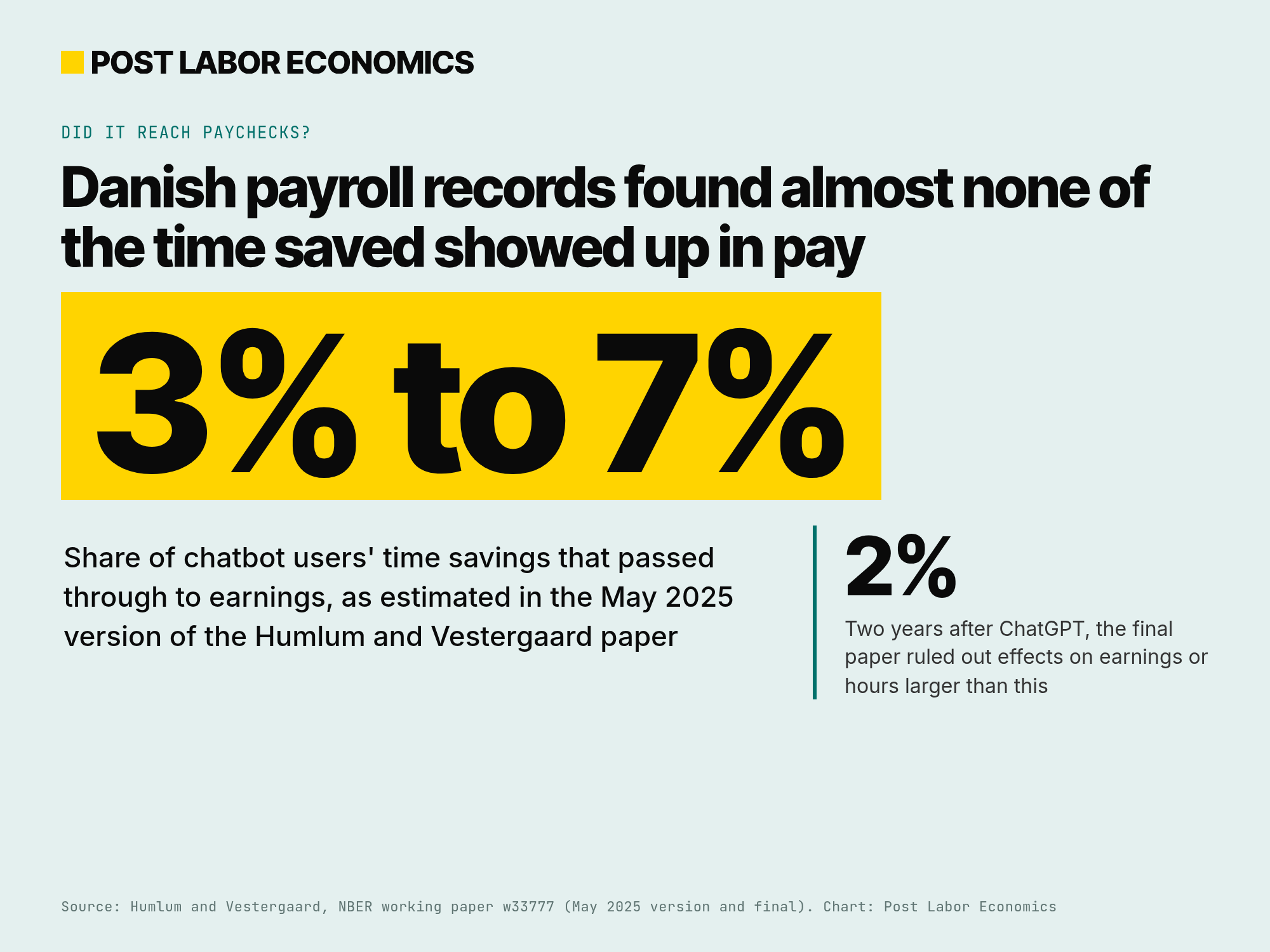
That’s the gap in one line. Workers report saving time, and very little of it comes back to them as money.
The work itself did change. Employers added new tasks such as checking AI output, and some adopters moved into better-paid occupations, though “still too few to move average earnings,” the authors wrote.
Employers report something similar from the other side. In a survey of nearly 9,000 executives in seven countries, AI had “essentially no net effect on firm employment” over the past three years, according to an NBER working paper by Ivan Yotzov, Nicholas Bloom and colleagues.
Those executives put AI’s boost to labor productivity growth at about 0.2% a year so far. They expect 0.6% a year over the next three years.
Here’s the comparison that matters. Friedberg’s chart assumed customers get back several times what they spend on AI. Anthropic’s own filing says that in the third quarter of 2026, its revenue from publicly traded Fortune 500 customers spending $100,000 or more a year averaged less than 0.1% of those companies’ total expenses.
Even a big return on a sliver of spending is a sliver. That’s a long way from the kind of money that funds raises.
What the company surveys say
The widely shared figure that 95% of companies get “zero return” from AI comes from MIT’s NANDA project, in a 2025 report it labeled preliminary findings.
It rests on structured interviews at 52 organizations and surveys of 153 leaders, plus a review of public AI projects.
The report itself calls its figures “directionally accurate based on individual interviews rather than official company reporting.” It counted success as a pilot that reached production with measurable results within six months, which is a high bar for anything new.
Its more useful finding is about workers. Only 40% of companies said they had bought an official AI subscription, while workers at over 90% of them reported regular use of personal AI tools.
The same report says executives were “hesitant to reveal the scope of layoffs due to AI,” but put cuts at 5% to 20% of customer support and administrative processing work at those companies.
Consulting firms’ surveys are sunnier, and they’re surveys of executives. In McKinsey’s 2026 State of AI, 37% of respondents said AI had added to their company’s profits, about the same share as a year earlier.
BCG’s Applied AI Index surveyed 1,330 senior executives and classed 48.5% of their companies as getting value from AI. The study notes its answers are self-reported.
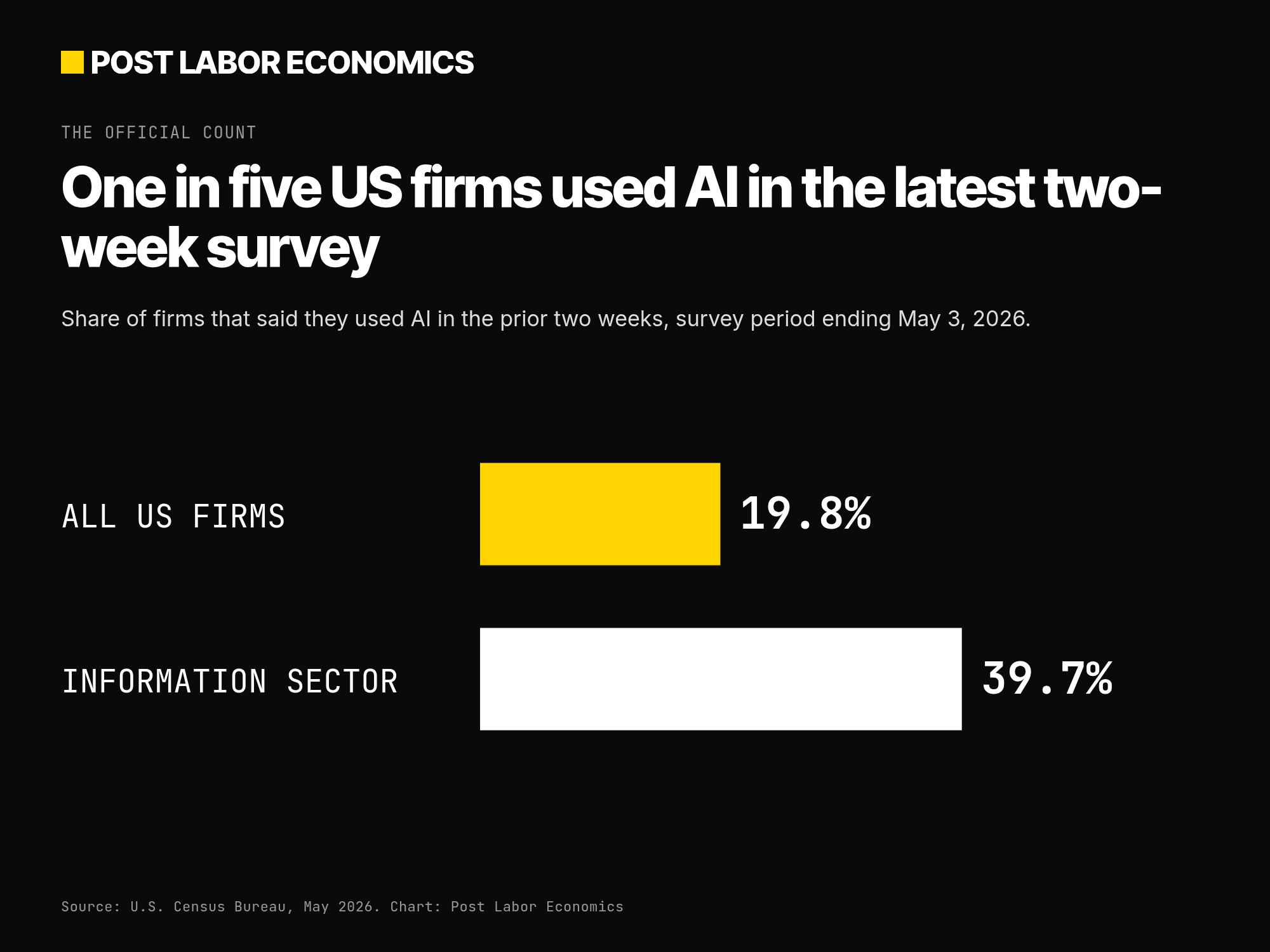
The official count of US businesses is lower than any of those. In the survey period ending May 3, 2026, just 19.8% of firms said they had used AI in the prior two weeks, according to the Census Bureau. In the information sector it was 39.7%.
The Microsoft example
Later in the episode, one of the hosts made the case that AI-era growth doesn’t cost jobs. “Microsoft’s revenue went from 198 billion to 332 billion in the last 4 years while staff only increased by 2,000 people,” the host said. “This idea that it creates job loss, I don’t think it’s true.”
The numbers are right. Microsoft reported $198.3 billion in revenue for fiscal 2022 and $331.8 billion for fiscal 2026 in its annual reports.
Headcount went from about 221,000 to about 223,000 over the same four years. That matches the host’s figure.
But the conclusion doesn’t follow from the numbers. Microsoft’s US headcount fell by about 1,000 over the period, to roughly 121,000.
Total headcount was flat at 228,000 in fiscal 2024 and 2025, then fell to 223,000 in fiscal 2026. And on October 26, Microsoft offered voluntary buyouts to about 60,000 employees, CNBC reported.
Flat headcount with soaring revenue is also exactly what job loss looks like when it happens through hiring that never takes place. Nobody gets a layoff notice for a job that wasn’t posted.
Who keeps the savings
My read: the AI payoff is real, and so far it’s showing up as a few percent of time saved, more output for newer workers, and big margins at the top of the chain. It isn’t showing up in paychecks, and Teradata’s memo shows why it might not on its own.
Back at Teradata, the trade looks lopsided on those numbers. Each employee gave up a raise that, by the two longtime staff members’ account, usually ran a few percent. What the company bought with it hasn’t yet shown up in anyone’s pay, there or anywhere else researchers have looked.
It also wasn’t the only option. Workplace strategist Jennifer Moss told Business Insider that companies can fund AI with debt, slower rollouts or thinner margins for a while, and that paying for it out of compensation is a choice.
“The reason workforce compensation ends up being the source is that it’s the largest controllable expense line at most companies and the one with the least organized resistance,” Moss said.
The amounts involved are modest. Companies in BCG’s January AI Radar survey expected to spend about 1.7% of revenue on AI in 2026, Business Insider reported.
Oxford economist Jan-Emmanuel De Neve read the signal differently than executives might hope. “The actual message traveling to the workforce is that they do not have a secure future in the organization,” he told the outlet.
Employment attorney Ellen Raim put the risk plainly. Talking about people mainly as costs “may make sense on a spreadsheet, but it can be corrosive inside an organization,” she said.
When a company says it’s “actively investing in AI,” as a Teradata spokesperson told Fortune, it’s worth asking which budget line paid for it. At Teradata, it was the one with your name on it.
If your company announces a big AI budget this winter, don’t wait for a memo like Teradata’s. Ask your manager or HR one question in writing before review season: is any of that money coming out of the raise pool?